

100 Number Chart Printable Practice for Grade 1
- Skill: Use a 100 chart to locate numbers and continue sequences
- Learning goal: Answer chart-location clues, identify patterns, and write the next numbers in a sequence.
- Format: Printable PDF worksheet
 Download Worksheet PDF
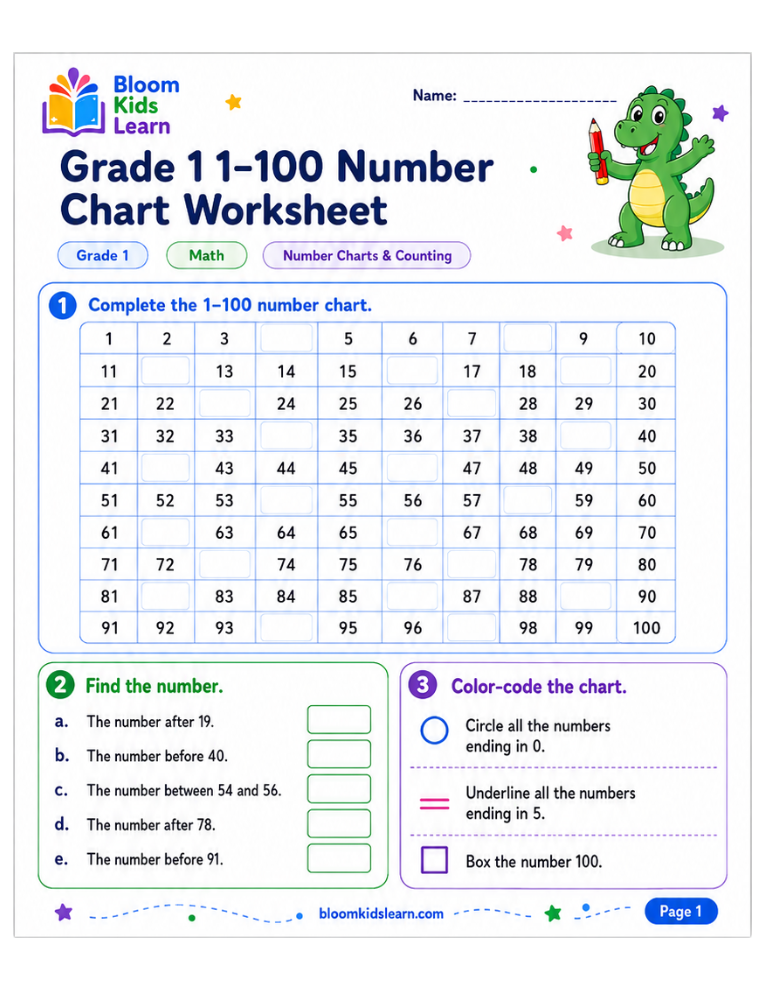
This 100 number chart printable practice page helps Grade 1 learners read a complete chart while solving location clues and short sequences. Questions use rows, columns, above, below, left, right, and what comes next.
Print the page for independent work, a warm-up, or partner practice. Ask the child to point to each answer on the chart before writing it in the box so visual reasoning stays connected to the numeral.
100 number chart printable practice skills
- Locate numbers in rows and columns
- Use above, below, left, and right language
- Continue counting-by-ones sequences
- Recognize even, odd, and multiple-of-ten patterns
Learning objective
Answer chart-location clues, identify patterns, and write the next numbers in a sequence.
What children do
Section 1 presents the full chart and location questions. Section 2 asks learners to mark even, odd, and multiple-of-ten numbers. Section 3 gives sequences that need the next three numbers.
Worked examples
The number below 34 is 44 on a chart arranged in rows of ten. For 14, 15, 16, the next three numbers are 17, 18, and 19. Even numbers end in 0, 2, 4, 6, or 8.
Use the Chart as a Map
This printable is about location as much as counting. Start by asking the learner to find a familiar number such as 10, 20, or 50. Then give one direction at a time: move right, move left, move up, or move down. On a standard ten-column chart, a move to the right changes the number by one and a move down changes it by ten. Have the child point to the path before writing an answer in the box.
Pattern-Marking Routine
Section 3 is easier when each symbol has a job. Read one direction, scan the chart, and mark only the numbers that match it. For multiples of 10, look for numbers ending in zero. For numbers ending in 5, scan the final digit rather than guessing from the row. After marking, ask the learner to name one example and explain why a nearby number does not belong.
Common Mistakes on This Printable
Children may confuse “below” with “after,” or slide diagonally when the clue asks for the number to the right. Draw a short arrow from the starting cell and count the spaces aloud. A child may also mark every even number when the direction asks for numbers ending in 5. Encourage a final digit check before the page is reviewed.
Support and Extension
For support, cover three rows and work in a smaller window. Use a ruler, transparent counter, or hand-drawn 1–100 strip to keep the eye on one line. For extension, ask the learner to invent a color key for a new pattern, then write two location clues for a partner. A “mystery route” can combine right two, down one, and left one; the child predicts the final number and proves it on the chart.
Answer Guidance
Review one answer from each section rather than marking the sheet silently. Ask which chart row, column, ending digit, or direction supplied the evidence. If an answer is changed, have the learner explain what clue corrected it. The explanation is the useful part of this practice because it shows whether the child can read a chart independently.
Home or Classroom Follow-Up
Use a wall calendar, seating chart, or hundred chart to repeat the same language: row, column, above, below, left, and right. Keep practice to a few clues and stop while accuracy is high. The goal is for the child to transfer chart vocabulary to new layouts, not memorize one page.
Related Number Chart Practice
For missing-cell practice, try the 1–100 number chart worksheet. For counting-sequence review, use Counting by 1s worksheets and then compare the larger jumps in Counting by 10s worksheets. The activity supports the official Grade 1 counting expectation.
FAQ
Does the learner need colored pencils?
No. Color can make the pattern-marking directions clearer, but pencil marks work just as well.
What if rows and columns are confusing?
Use a ruler to trace one row, then compare it with a vertical column before trying a new clue.
Mini-Lesson for Independent Readers
Model the first clue by naming the start cell, direction, and number of spaces. Solve the next clue together, then let the learner work alone while you listen for the same language. When a pattern asks for the next three numbers, have the child point to each step and say the sequence before writing. This keeps the chart from becoming a silent coloring task.
Progress Check
Save the page as a quick record of which clue types are secure. A learner is ready for a harder chart activity when they can find a location, mark a digit pattern, and continue a sequence with a short explanation. If one area remains difficult, repeat only that section with a smaller chart and return to the full printable later.
 Preview


