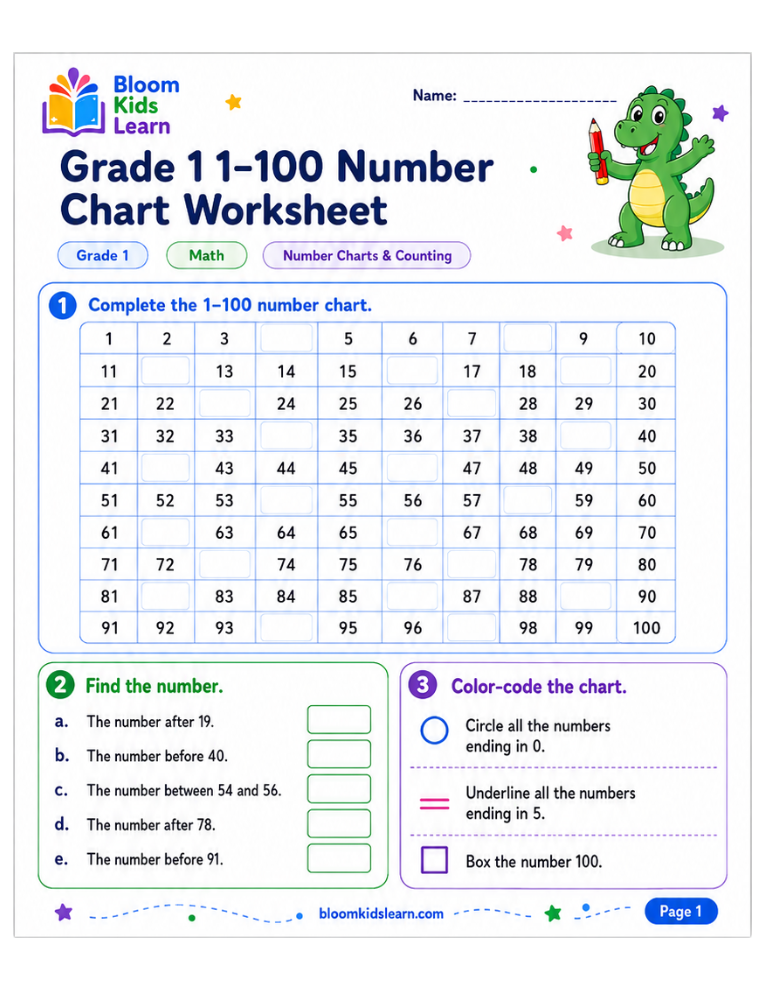

Counting to 100 Number Chart Worksheet for Grade 1
- Skill: Count forward by 1s, 2s, 5s, and 10s on a 1-100 chart
- Learning goal: Use a 1-100 number chart to complete patterns, follow skip-counting paths, and answer number clues.
- Format: Printable PDF worksheet
 Download Worksheet PDF
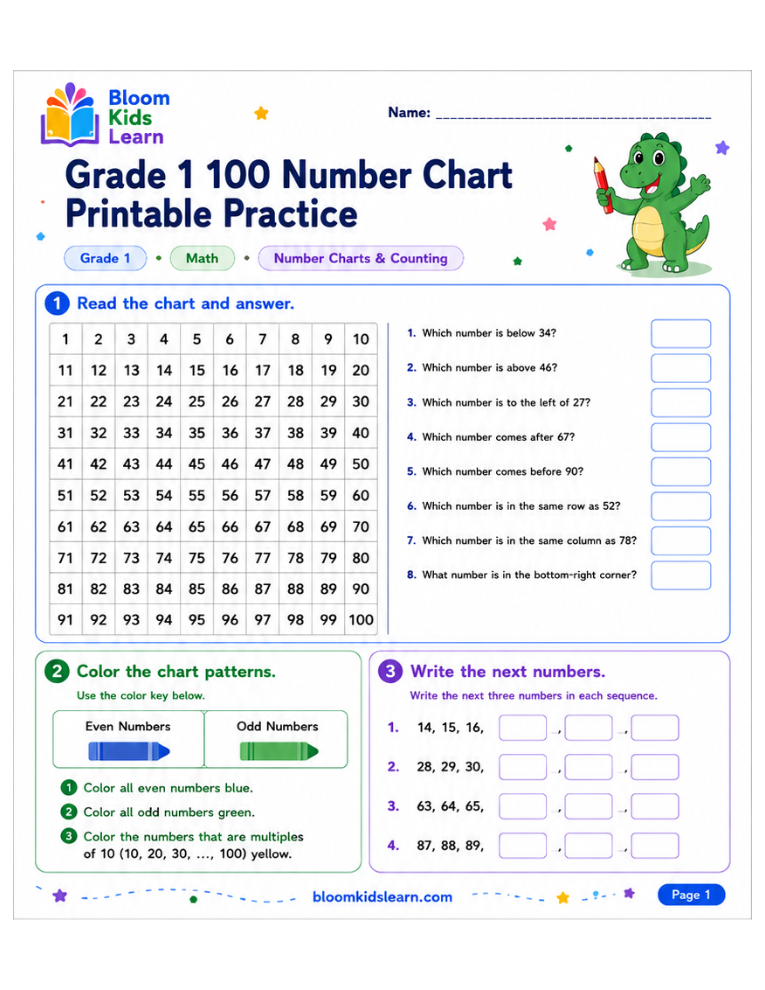
This counting to 100 number chart worksheet for Grade 1 combines a full chart with short skip-counting rows, object groups, number paths, and chart questions. It gives children several ways to see the same numbers instead of asking them to memorize one list.
Use the printable after a lesson on counting patterns, as a review center, for homework, or during tutoring. A child can complete one section at a time and return to the page later for a second, more independent attempt.
Counting to 100 number chart Skills
- Read and complete a 1-100 chart
- Count by 1s, 2s, 5s, and 10s
- Continue patterns from different starting numbers
- Use a chart to answer before, after, and between clues
Learning objective
Use a 1-100 number chart to complete patterns, follow skip-counting paths, and answer number clues.
What learners do on the page
Section 1 asks learners to fill chart gaps and mini charts. Section 2 moves through skip-counting by 2s, 5s, and 10s. Section 3 uses objects and asks for the next three numbers. Section 4 provides chart questions such as what comes after 59 or between 84 and 86.
Teaching routine
Warm up by counting aloud to 20, then point to 20, 30, 40, and 50 on the chart. Model one row of missing numbers and one skip-counting row. Ask the child to trace each jump with a finger before writing. Keep counters grouped in tens nearby when the visual pattern is hard to hold in mind.
Worked examples
Fill a chart row
In 1, 2, 3, blank, 5, the missing number is 4. Read the entire row after writing it.
Skip count by 5s
For 5, 10, 15, 20, 25, blank, the next number is 30 because each jump adds five.
Use an object group
If six apples are shown and the first number is 6, the next three counting-by-ones values are 7, 8, and 9.
Common mistakes
Children may switch from a skip-counting rule to counting by ones. Ask, “How large is one jump?” Some may write 51 after 40 in a tens row; point to the chart and compare the distance between rows. When a child loses track, return to the last printed number and continue aloud.
Support and extension
For support, complete the 1s section first and highlight the starting number in each row. For extension, ask a learner to write a new pattern that starts at 35 and counts by 5s, then hide two values for a partner to solve.
Answer guidance
Check each row by naming the difference between neighboring values. A correct answer should fit the chart and the stated rule. For clue questions, ask the learner to point to the starting number and show the move before confirming the written answer.
Home or classroom follow-up
Place the completed page in a math folder and revisit one section later in the week. Ask the learner to explain one 10-jump and one 5-jump without looking at a completed example.
Why the chart helps
A chart makes number order visible. Moving one box to the right usually adds one, while moving one row down adds ten. Looking at the pattern helps learners connect spoken counting, written numerals, and early place-value ideas. Encourage children to describe the move instead of relying on a lucky guess.
When a learner is unsure, use a gradual release routine: model one example, solve the next together, and let the child try a third independently. Ask the child to circle the starting number, draw a small arrow, and check the answer against a neighboring clue. These habits make the printable useful for intervention as well as regular practice.
Self-check routine
Before the page is filed, choose two answers and ask the learner to prove them. One proof can use the row pattern and the other can use a chart move. If an answer is wrong, erase only that box, return to a known number, and count again. Explaining a correction is more valuable than copying a finished key.
Keep language simple and specific: say one more, one less, five more, or ten more rather than simply saying “look at the chart.” Invite children to touch each number as they speak. This supports careful handwriting and helps a teacher see whether a mistake came from counting, reading, or recording the numeral.
For a small-group lesson, pause after each section and let learners compare strategies. One child may use a chart row while another counts objects or draws a number line. Accept both explanations when the number relationship is correct, then model the chart language you want them to use in future practice.
Related Grade 1 practice
Use the Number Charts & Counting collection to move between chart skills. For consecutive-number review, try Counting by 1s worksheets. Learners ready for larger equal jumps can use Counting by 10s practice. The work connects with the official Grade 1 counting expectation.
FAQ
Can I use this in a math center?
Yes. Keep a number chart, pencil, and small number line nearby so children can check a move independently.
How long should practice take?
Plan for 10 to 20 focused minutes. Stop when accuracy drops and return another day.
 Preview