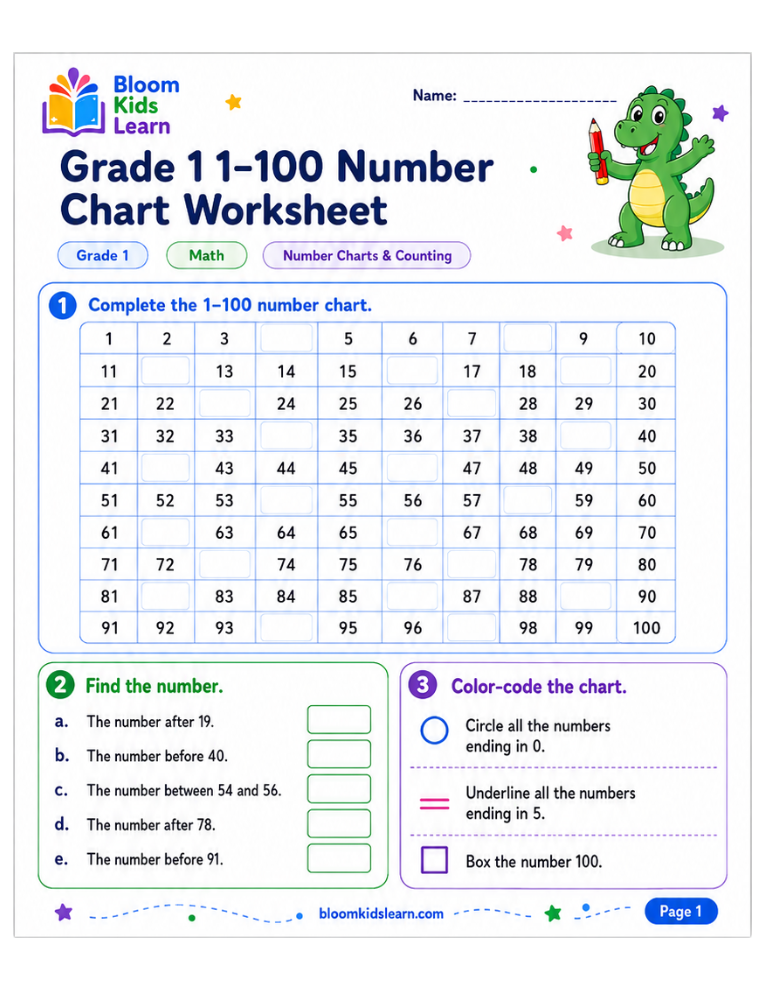

Missing Numbers 1–100 Worksheet for Grade 1
- Skill: Find missing numbers from 1 to 100 using charts and number lines
- Learning goal: Complete missing-number charts, lines, and sequences from 1 to 100 and explain each answer.
- Format: Printable PDF worksheet
 Download Worksheet PDF
Missing numbers 1 100 worksheet questions can look similar while requiring different strategies. A blank on a hundred chart is solved with rows and columns; a number line depends on the size and direction of each jump. a number train must be read as one continuous sequence. This Grade 1 worksheet gives children practice choosing the right clue for each format.
How to use and solve this missing numbers 1 100 worksheet?
Find the nearest printed numeral and decide how the chart moves. Across a row, each square is one more from left to right. Down a column, each square is ten more. If the blank sits between 47 and 49, write 48, then check that the number below would be 58.
Near the end of a row, pay attention to decade transitions. After 59 comes 60, and the next row continues with 61. A child who understands the sequence but places 60 in the wrong column needs chart-layout practice rather than more counting from 1.
Missing numbers on a number line
Before filling any blank, inspect two printed labels and identify the jump. The line may increase by 1, 2, 5, or 10. Mark one hop at a time. If the labels are 20, 25, __, 35, the equal jump is 5, so the missing value is 30.
Do not assume every number line counts by ones. A correct strategy should work for every interval shown.
Easy way to solve Number trains problem.
Read the entire train from the engine toward the final car. Use two neighboring cars to find the rule, then continue in the same direction. If the train shows 32, 34, __, 38, it is adding 2 and the missing car is 36. Recheck the row after writing; one incorrect car can make later answers drift away from the rule.
Before, after, and between
Before means one less in an ordinary counting sequence. After means one more. Between is the number with one neighbor on each side. For example, 72 is before 73, 74 is after 73, and 73 is between 72 and 74.
Pay attention to the position of the blank. In 47, 48, __, 50, a child who writes 51 may be looking only at the final printed number instead of noticing that the blank sits before 50.
What mistakes can tell you
- Using +1 on a line that jumps by 5 means the rule was not checked first.
- Writing a correct number in the wrong chart square suggests a row-and-column issue.
- Reversing a decreasing train means the child may be reading from the wrong end.
- Confusing before and after calls for position language, not a full worksheet rewrite.
Check each answer in its own format
On the chart, use a horizontal and vertical neighbor. On the number line, repeat the jump. On the train, read the completed sequence from start to finish. For before-and-after items, say the three-number sequence aloud.
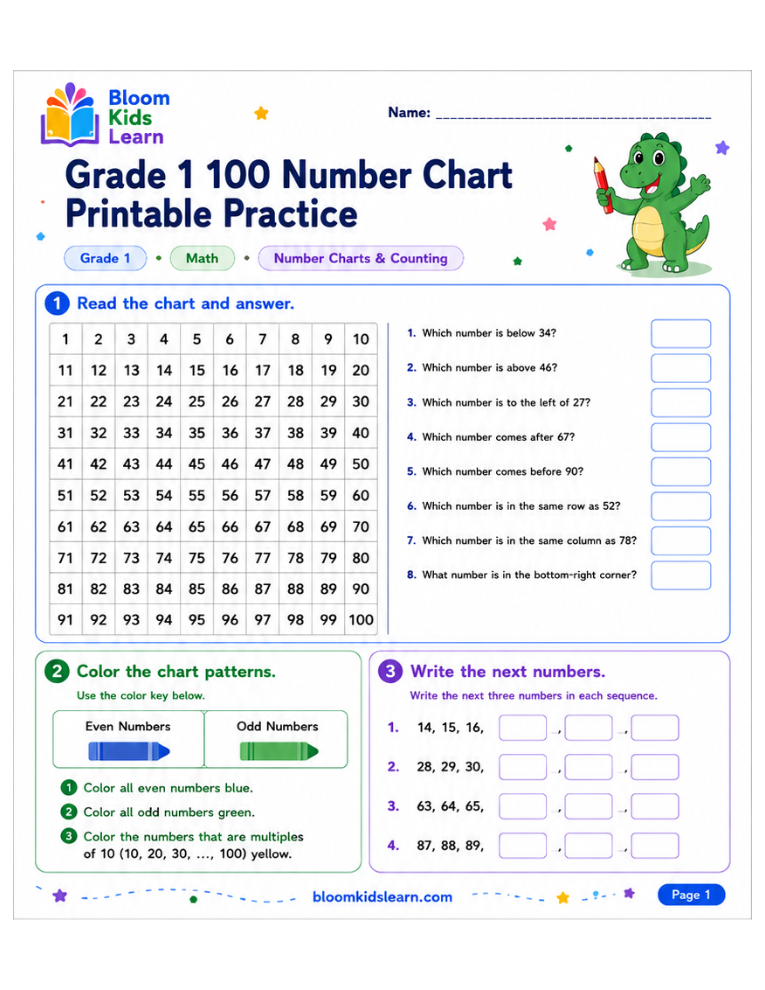
Use the 1–100 Number Chart Worksheet for focused chart structure or the 100 Chart Challenge for multi-step reasoning. These related pages build the same number-order knowledge through different tasks.
 Preview