
Worksheet Topic
Number Charts & Counting Worksheets
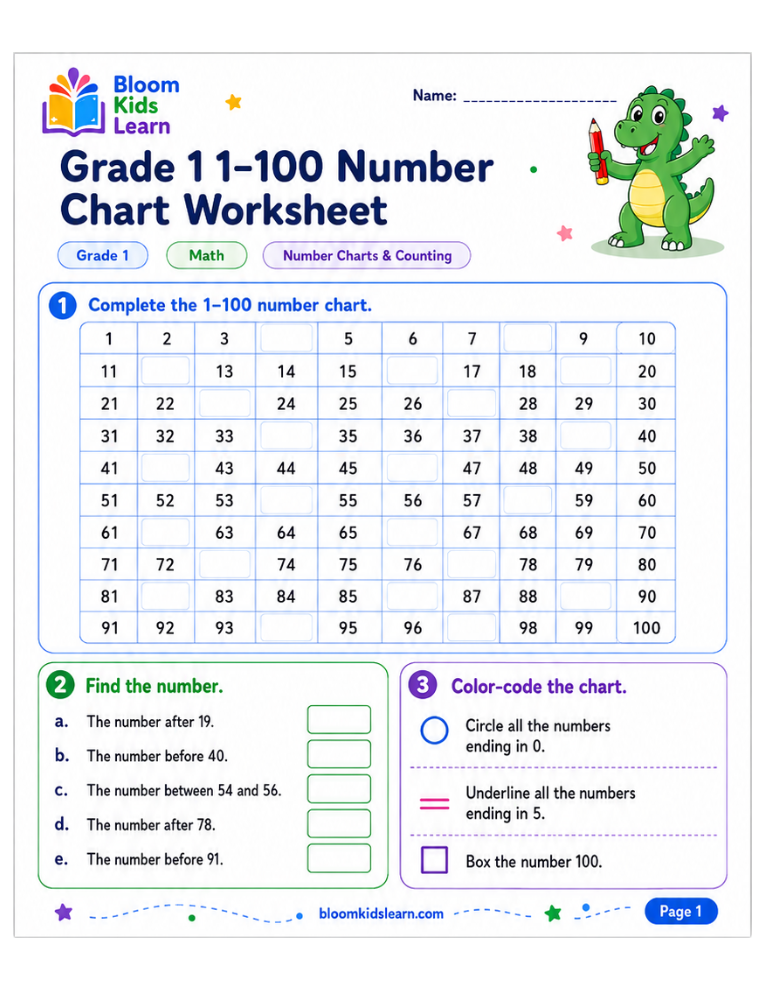
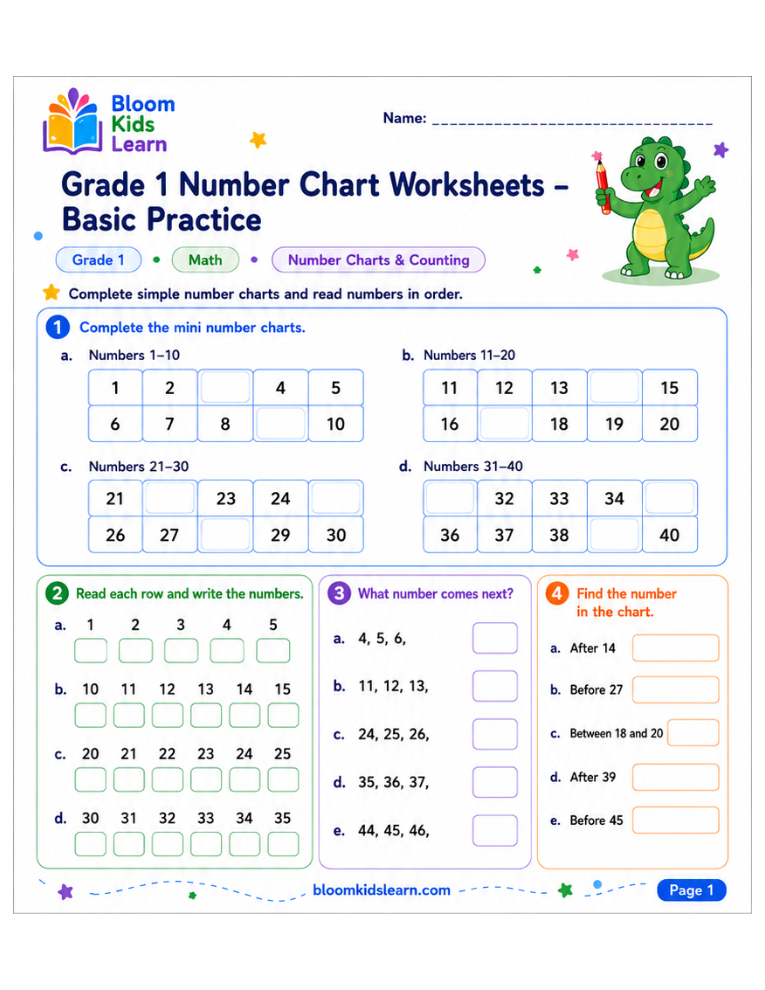
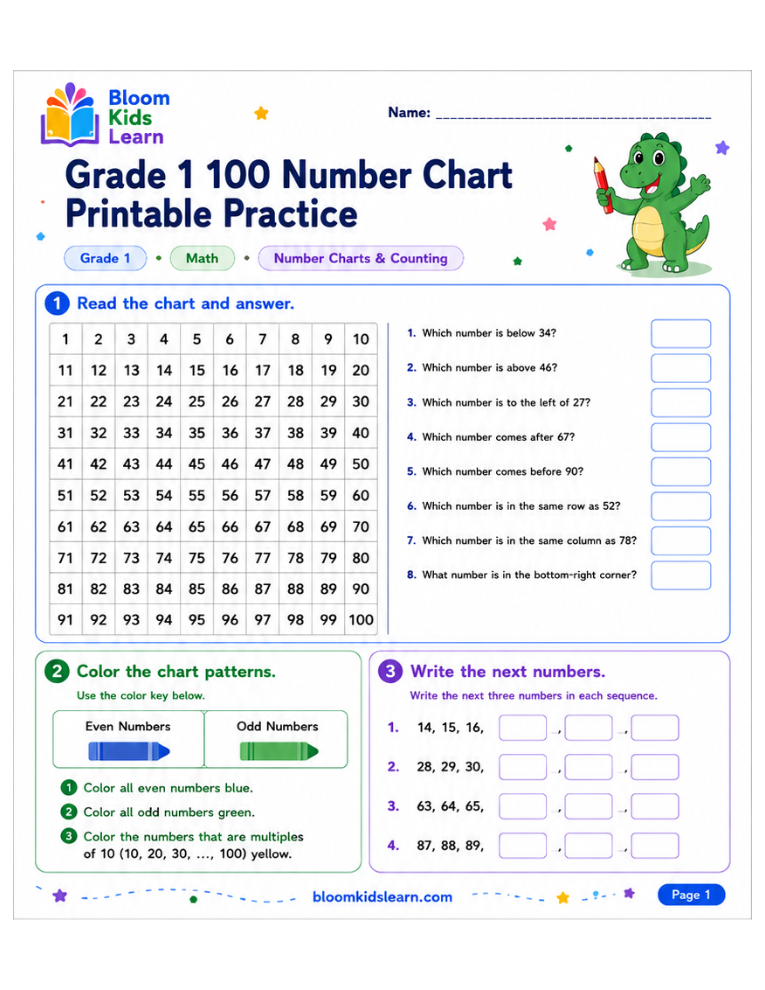
Number charts give Grade 1 learners a clear place to see how numbers are ordered, grouped, and connected. This Number Charts & Counting collection brings together six printable math worksheets built around the 1-100 chart. Children complete charts, read rows and columns, count forward and backward, identify numbers before and after, and use clues to explain where a number belongs.Each page is designed for US Letter printing and can be used in a classroom math center, guided small group, tutoring session, homeschool lesson, morning work, or calm practice at home. The activities use familiar numbers while adding just enough variety to keep the work meaningful. Some pages focus on filling missing numbers; others ask learners to trace patterns, solve chart moves, or use a number chart to reason about a clue.What is inside this Grade 1 number chart collection?The basic practice worksheet introduces short 1-20 and 1-40 mini charts, read-and-write rows, and simple before-and-after questions. It is a useful starting point for a child who is still learning how a chart is organized. The counting-to-100 worksheet connects the full chart with counting by 1s, 2s, 5s, and 10s. Learners can see that skip-counting patterns are easier to find when the rows and columns stay visible.The 1-100 number chart worksheet gives repeated practice with missing cells, number clues, and visual patterns. The printable practice page asks children to locate a number below, above, to the left, or to the right of another number. The missing-numbers worksheet uses charts, number lines, number trains, and before-after-between prompts. Finally, the challenge worksheet presents trickier chart gaps, moves, hidden-number clues, and short path problems for learners who are ready to explain their reasoning with less support.Skills children practiceRead and write numerals from 1 to 100.Count forward and backward by 1s on a hundred chart.Recognize rows, columns, and neighboring numbers.Find one more, one less, ten more, and ten less.Complete missing-number sequences and number lines.Use chart clues to locate a hidden number.Describe a pattern using clear math language.Check an answer by looking at the numbers around it.How to use the worksheetsBegin with a quick chart walk. Ask the learner to point to 1, 10, 11, 20, 50, and 100. Talk about what changes when you move one space to the right and what changes when you move one row down. On a standard 1-100 chart, moving right usually adds one and moving down usually adds ten. Saying the rule aloud helps children understand the chart instead of treating it as a page of unrelated boxes.Choose the worksheet that matches the learner’s current need. Use basic practice when the chart itself is new. Use counting to 100 or the printable practice page when a child can read most numerals but needs fluency. Use missing numbers for careful sequence work, then reserve the challenge page for learners who can combine more than one clue. A short session of ten to fifteen minutes is usually enough. Stop before fatigue changes careful counting into guessing.Teaching with objects and movementA hundred chart becomes easier to understand when it is connected to something concrete. Build groups of ten with linking cubes, buttons, craft sticks, or small blocks. Place one group beside another and count 10, 20, 30. Then point to the corresponding chart row. For a movement break, place number cards on the floor and ask the child to step one space forward, one space back, or one row down. These quick activities reinforce the same relationships used on the printable pages.Worked examplesIf a row reads 21, 22, blank, 24, the missing number is 23 because the sequence increases by one. If a clue asks for the number below 34, look one row down in the same column: 44. If the question asks for ten more than 67, move down one row to 77. For a number between 54 and 56, the answer is 55. Encourage children to show the move or name the neighboring numbers before writing the final response.Support, extension, and differentiationFor support, cover only one blank at a time, provide a small number line, or let the child point while an adult reads the direction. Highlight the starting number and draw an arrow to the space that must be checked. For learners who need a challenge, remove more chart clues, start from a number that is not a multiple of ten, or ask the child to write a new clue for a partner. A strong extension is to create a path with two moves, such as right three and down one, and predict the final number before checking the chart.Answer guidanceAnswers should be checked by the relationship around the space, not only by an answer key. A missing number in a row should be one more than the number before it and one less than the number after it. A vertical move should change by ten on a standard chart. If a child makes an error, return to the closest printed number and count from there. Ask for a sentence such as, “I wrote 58 because it comes after 57 and before 59.” This explanation shows understanding and builds self-correction.Grade 1 standards contextThe activities support the Grade 1 Common Core expectation that students count to 120, starting at any number less than 120, and read and write numerals. The chart also provides a visual bridge to place value: moving down a row changes the tens while keeping the ones relationship visible. These worksheets are practice tools, not a complete curriculum. Pair them with oral counting, manipulatives, discussion, and opportunities to solve problems in everyday settings.Related practiceWhen a learner needs more consecutive-number practice, continue with the Counting by 1s collection. For one-less and backward work, use Backward Counting worksheets. When the child is ready for equal jumps, try Counting by 2s, Counting by 5s, or Counting by 10s. Moving between related collections lets children revisit the same number relationships in a new format without unnecessary repetition.Frequently asked questionsWho are these worksheets for?They are written for Grade 1 learners, but they also work for kindergarten enrichment, intervention, tutoring, and Grade 2 review.Can I print the pages in black and white?Yes. The boxes, directions, and number patterns remain readable without color, although color can help with pattern-marking activities.How should I choose the first page?Start with basic practice if the chart is unfamiliar. Choose missing numbers or printable practice when the learner can already locate most numbers. Save the challenge page for independent review.What if my child counts correctly but cannot explain the moves?Use a physical chart, point to the starting number, and model one move. Ask the child to describe what changed before solving the next clue.Can the pages be reused?Yes. Place a page in a dry-erase sleeve for repeated practice, or print a fresh copy later and compare which supports the learner still needs.
Learning Objectives
✓Read and write numerals from 1 to 100.
✓Use rows and columns to find one more, one less, ten more, and ten less.
✓Complete missing-number sequences and explain chart patterns.
✓Use a number chart to solve location and counting clues.
 Preview
 PDF