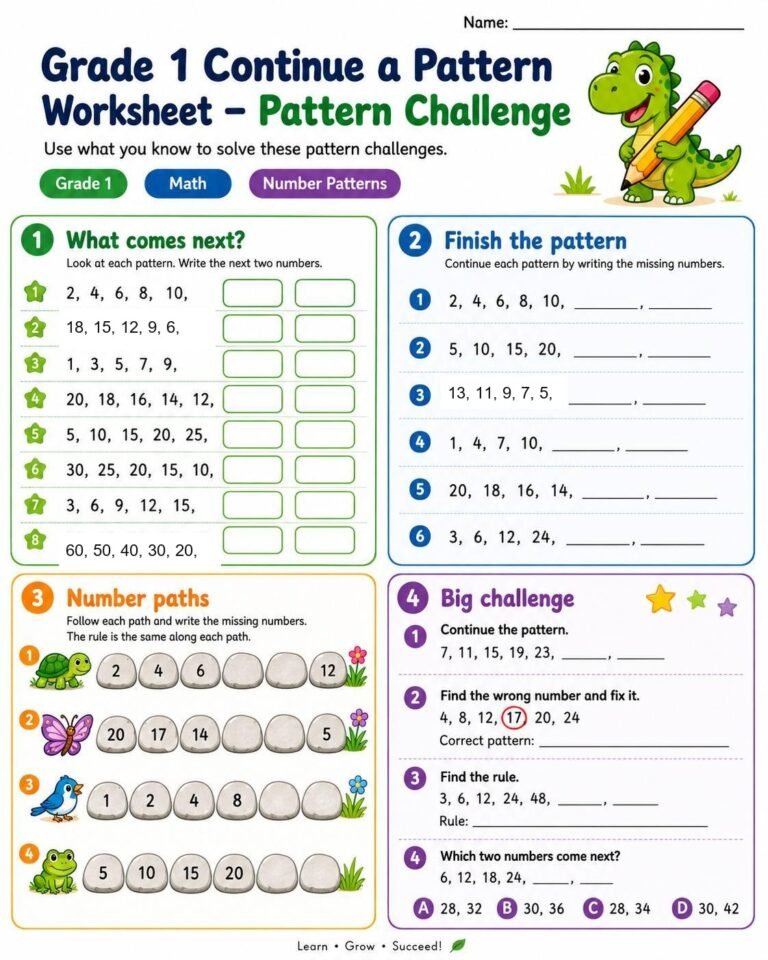

Count Forward by 1 Pattern Worksheet for Grade 1
A free Grade 1 pattern worksheet for counting forward by 1, completing number sequences, and solving missing-number paths. Includes an answer key.
- Skill: Continue number patterns by adding 1
- Learning goal: Identify an add-1 rule and extend forward-counting sequences within 100.
- Format: Printable PDF worksheet
- Answer key: Separate PDF available
 Download Worksheet PDF
 View Answer Key
Counting forward by one sounds simple, but a child must keep the order of numbers steady even when a sequence begins at 45, crosses 79–80, or contains blanks in the middle. This printable gives Grade 1 learners focused practice with that exact skill. Instead of beginning every row at 1, it uses different starting points so children learn to continue a sequence rather than recite only a memorized count.
What children do on this worksheet
The first activity shows five consecutive numbers and asks for the next three. Learners continue sequences such as 45, 46, 47, 48, 49 and 78, 79, 80, 81, 82. The second activity places blanks inside a sequence, so the child must use numbers on both sides as clues. Pattern paths then turn the same add-1 idea into a visual stepping-stone task. A short challenge checks before-and-after knowledge and independent counting from 73.
How to teach the add-1 rule
Ask the child to read one row aloud and point to each number. Then ask, “What changes each time?” The useful answer is not only “the numbers get bigger” but “each number is one more.” Model one example: 12, 13, 14, 15, 16. Start with 16, add one, and write 17; repeat for 18 and 19. This connects spoken counting to a repeatable rule.
If the learner loses the sequence at a decade change, place 78, 79, and 80 on a small number line. Explain that after 79 the tens digit changes while the ones digit returns to zero. Let the child say the transition before writing it.
Mistakes that reveal useful information
- Repeating the last printed number: the child may not understand that the blanks continue the row.
- Writing 79, 90 after 78: the difficulty is the decade transition, not pencil control.
- Filling only alternate blanks: ask the child to touch every space while counting.
- Writing neat but incorrect numbers: work on counting order before adding more handwriting practice.
Simple ways to use the printable
For a first attempt, complete one item from each section together and let the child finish the rest independently. In a small group, give each learner a starting number and build a spoken chain by adding one. At home, use coins or counters: place 34 counters, add one, and name the new total. This makes “add 1” concrete without turning the page into a formal addition lesson.
Answer guidance and next step
Check that every entry is exactly one more than the number before it. The included Continue a Pattern answer key lists answers in worksheet order. A child who completes this accurately can move to the skip-counting by 2s pattern worksheet. If the rule is still unclear, use our number pattern worksheets collection for shorter rule-identification practice before continuing longer sequences.
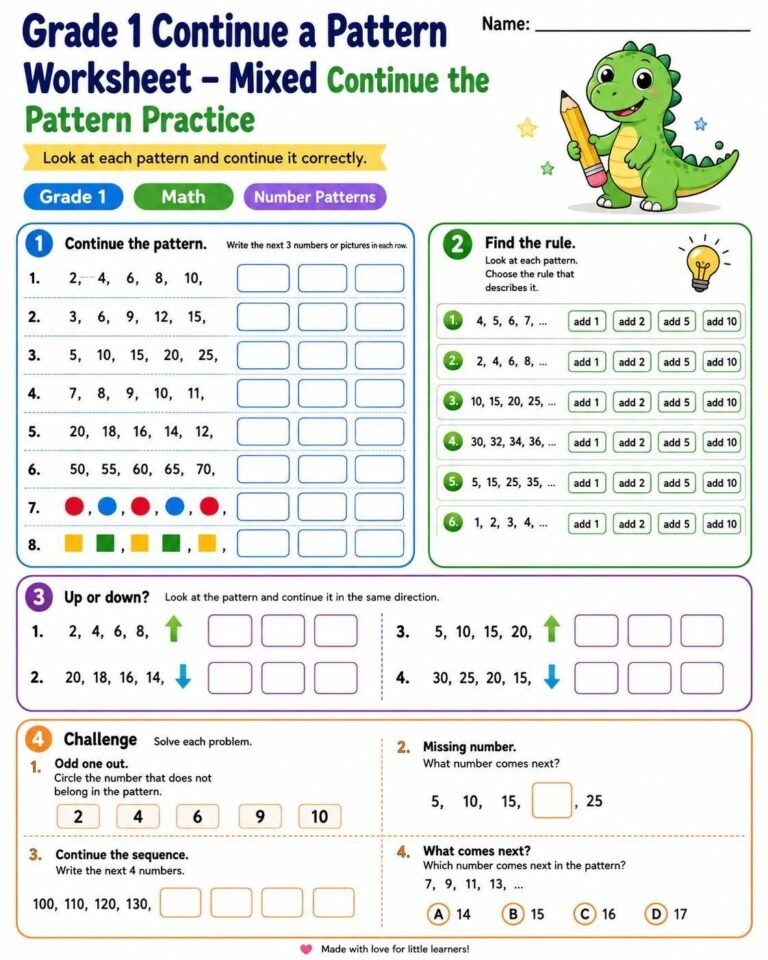
 Preview