
Match the Middle Sound Worksheet for Grade 1
Match picture words to short-vowel middle sounds, trace a, e, i, o and u, and move into independent sound choices and writing.
- Skill: Match CVC picture words with their short-vowel middle sounds
- Learning goal: Say a pictured CVC word, isolate its medial vowel phoneme, and connect that sound with a, e, i, o or u.
- Format: Printable PDF worksheet
- Answer key: Separate PDF available
 Download Worksheet PDF
 View Answer Key
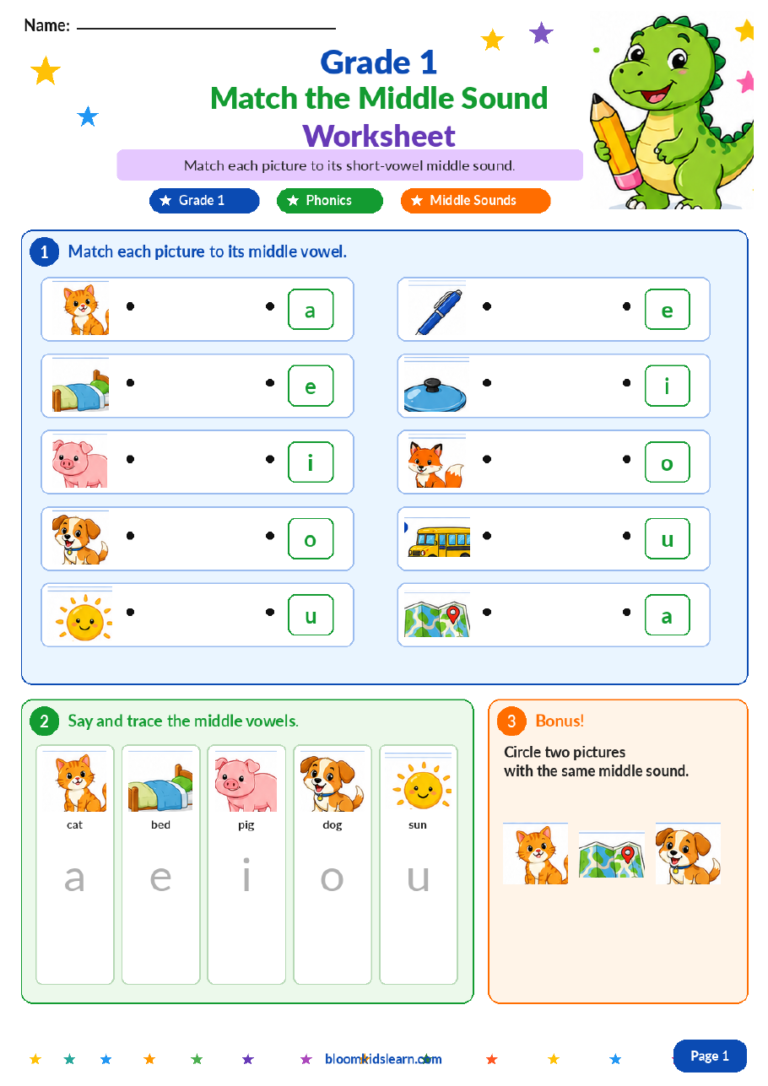
Say cat slowly: /c/ /a/ /t/. The sound between the first and last sounds is /a/. This two-page match the middle sound worksheet for Grade 1 gives children a picture cue, asks them to listen for that medial vowel, and connects the sound to the letters a, e, i, o, and u.
Download and Print the Middle Sound Matching PDF
The supplied middle sounds answer guide is also available for checking the core items. Open-response work may have more than one acceptable answer.
What Does This Grade 1 Worksheet Practice?
The main job is to hear the short vowel in the middle of a simple picture word and match it to its letter. That combines phonemic awareness with sound-to-letter knowledge. A child first notices the sound in speech, then links /a/, /e/, /i/, /o/, or /u/ to the written vowel.
The worksheet keeps the consonants familiar and uses concrete CVC words. Examples include cat, bed, pig, dog, sun, pen, lid, fox, bus, and map. Because the pictures carry the meaning, a learner can concentrate on the vowel instead of spending all their effort decoding an unfamiliar word.
What’s Included in This Worksheet?
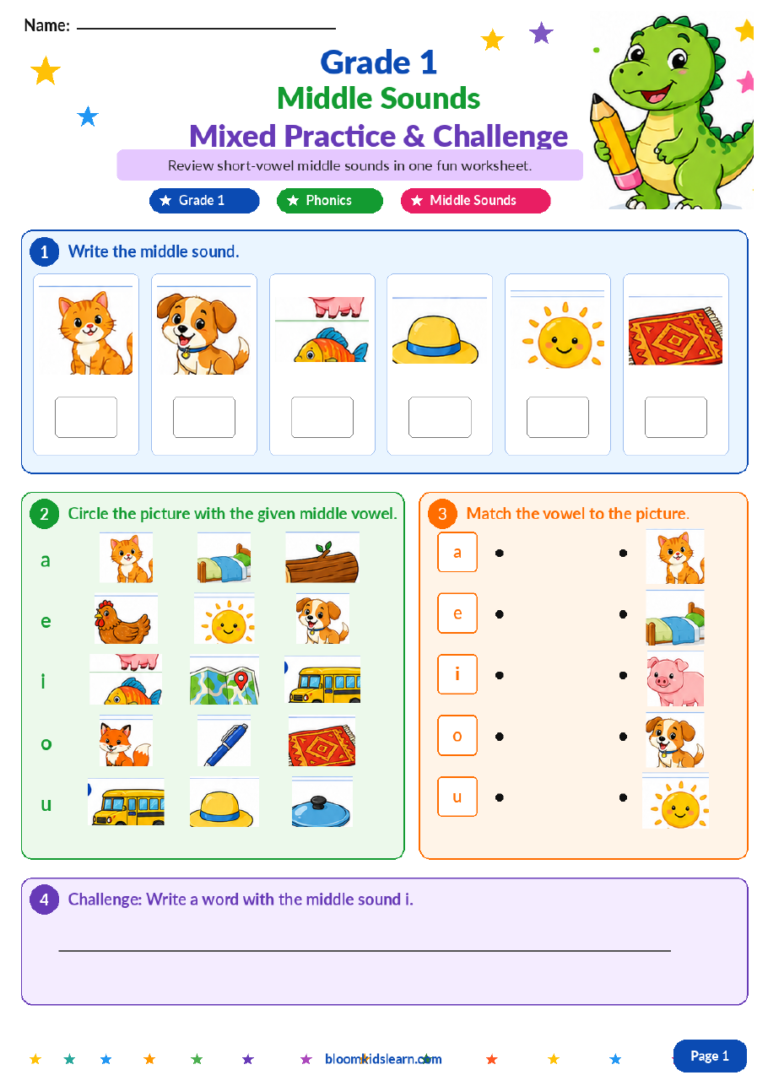
Page 1 starts with picture-to-vowel matching. The first set includes cat, bed, pig, dog, and sun; a second column adds pen, lid, fox, bus, and map. Children then say five model words and trace the middle vowels. A small comparison task asks them to find two pictures with the same middle sound.
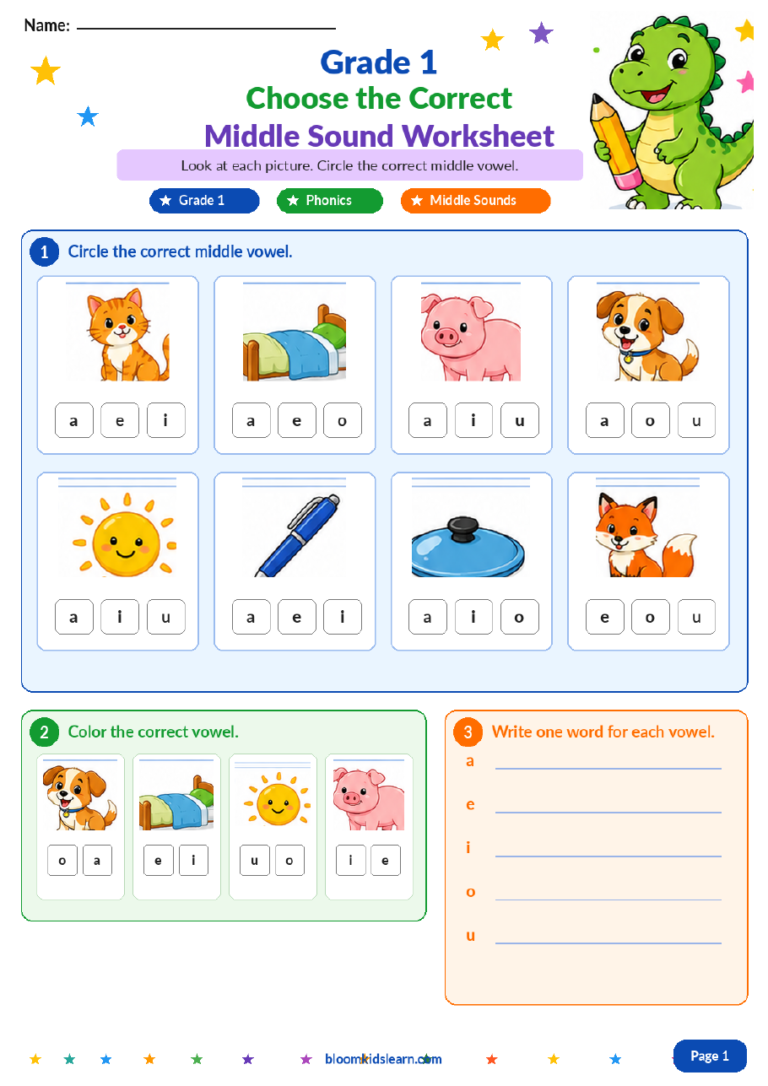
Page 2 raises the demand. Learners choose from a, e, i, o, and u under ten pictures, find a picture that matches each given vowel, and finally write the middle sounds in mug, hen, lid, and dog. The sequence moves from matching to selecting and then to recalling a letter independently.
How to Teach Middle-Sound Matching
Begin orally. Point to the cat and ask the learner to name it. If the picture is unclear, supply the word; this is a listening task, not a picture-naming test. Say cat normally, then stretch it once: /c/ /a/ /t/. Tap three counters or fingers as you say the three sounds. Ask, “Which sound was in the middle?” Only after the child answers /a/ should you point to the letter a.
Repeat the same routine with one example for each vowel: cat, bed, pig, dog, and sun. Keep the vowel sound short. If a child says the vowel’s name instead of its sound, model the word again rather than simply marking the answer wrong.
How to Use This Worksheet
- Name every picture together before beginning.
- Ask the child to say one word and segment it into three sounds.
- Have the child repeat only the middle sound.
- Match or choose the vowel letter after the sound is identified.
- Complete one short row at a time. Pause if answers become guesses.
- Review errors orally, then let the child correct them independently.
For extra support, cover four vowel choices and compare only two, such as e and i. For an extension, cover the pictures after the page is complete and ask the learner to read the written CVC words.
How Does This Worksheet Help Grade 1 Students?
Matching lowers the handwriting load, so it is useful when a child can hear sounds more readily than they can write letters. The page also reveals the source of an error. A learner who cannot isolate the middle sound needs more oral segmentation. A learner who says /o/ correctly but points to u needs sound-to-letter mapping practice. Those are different needs and should not receive the same correction.
Common Mistakes and How to Help
The child matches by the picture’s first sound. Cover the letter choices, stretch the whole word, and tap the middle counter. Ask for the second sound rather than “the vowel” until the position is secure.
Short e and short i are confused. Work with a small contrast such as bed/pig or hen/lid. Say one word at a time and let the learner hold up e or i. Avoid adding several other vowels until the contrast becomes clearer.
The answer is chosen without saying the word. Make spoken rehearsal part of the routine: name, stretch, isolate, then match. If the child can explain the middle sound before drawing the line, the response is less likely to be a visual guess.
What Should Your Child Practice Next?
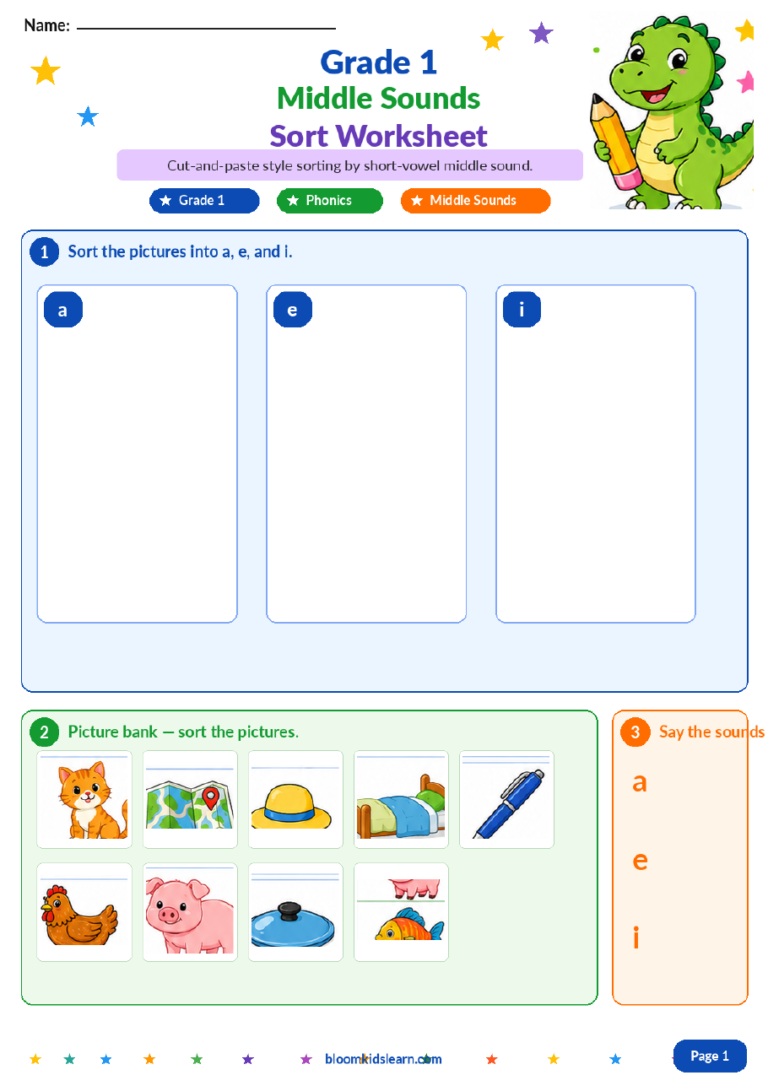
When matching is comfortable, move to the Choose the Correct Middle Sound Worksheet. It asks learners to discriminate among several possible vowels. The Grade 1 middle sounds worksheet collection shows the full progression. If individual vowel sounds are still uncertain, revisit the Grade 1 short vowel worksheets.
Frequently Asked Questions
How do you teach a child to match middle sounds?
Use a spoken CVC word, segment it into three sounds, and ask for the second sound before showing the vowel letters. Connect the heard sound to its letter only after the child has isolated it.
Why should children say the picture word before matching the vowel?
The picture alone does not contain a sound. Saying the word gives the learner something to listen to and reduces matching based on color, position, or guessing.
How does middle-sound matching support Grade 1 reading?
It draws attention to the vowel that holds the center of many CVC words. Recognizing that sound makes it easier to blend and distinguish words such as cat, cot, and cut.
What if my child keeps choosing the wrong vowel?
Return to oral practice with two contrasting vowels. If the child hears the sound but selects the wrong letter, review the letter-sound connection rather than repeating the whole worksheet.
 Preview