
Choose the Correct Middle Sound Worksheet for Grade 1
Choose among possible vowels for each picture word, compare sounds across rows, and explain the middle sound before recording it.
- Skill: Discriminate among short-vowel middle sounds in CVC words
- Learning goal: Listen to a pictured CVC word and select the vowel letter that represents its middle phoneme.
- Format: Printable PDF worksheet
- Answer key: Separate PDF available
 Download Worksheet PDF
 View Answer Key
A child may know the picture is a pig and still be unsure whether the middle sound is represented by e, i, or u. This choose the correct middle sound worksheet for Grade 1 makes that decision visible. Learners say each CVC word, compare the vowel choices, and select the grapheme that matches the sound they hear.
Download and Print the Correct Middle Sound PDF
Download the Middle Sounds Answer Key PDF
The supplied middle sounds answer guide lists answers for the core picture words. Original word-writing responses can vary when they contain the requested short vowel.
What Does This Grade 1 Worksheet Practice?
The activity targets short-vowel discrimination in the medial position of CVC words. Each question offers plausible vowel choices, so the learner must listen instead of completing a familiar visual pattern. It also practices using picture cues, segmenting three sounds, connecting phonemes with graphemes, and checking a word by blending it again.
What’s Included in This Worksheet?
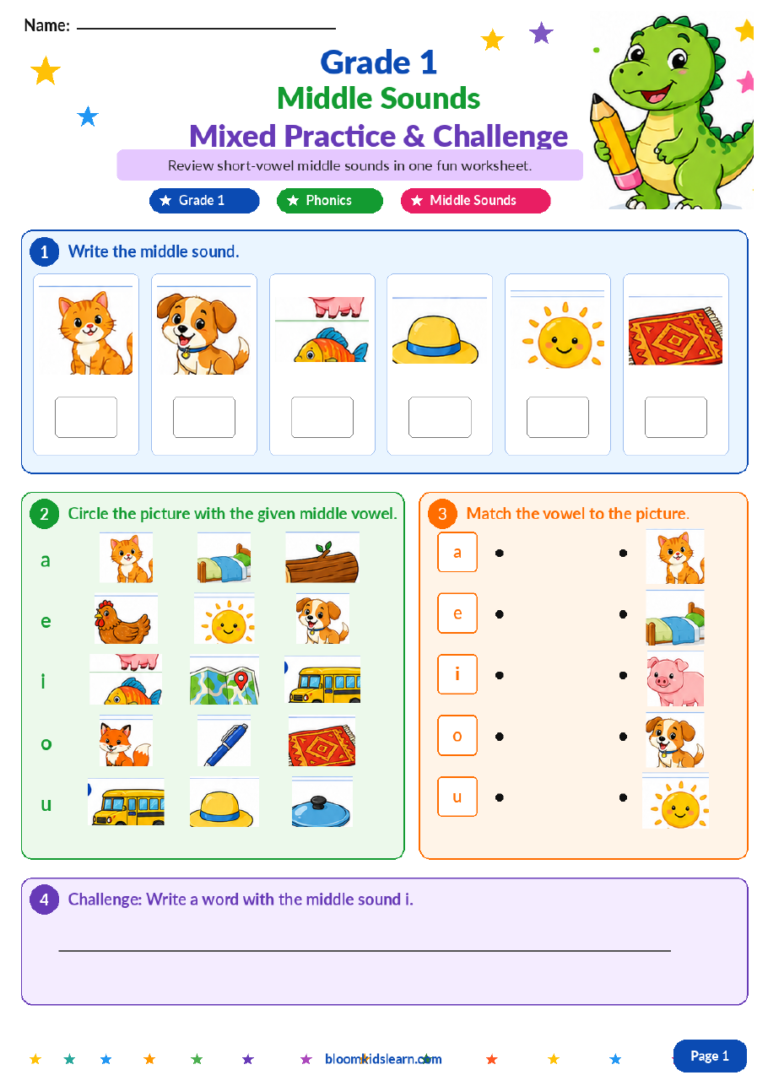
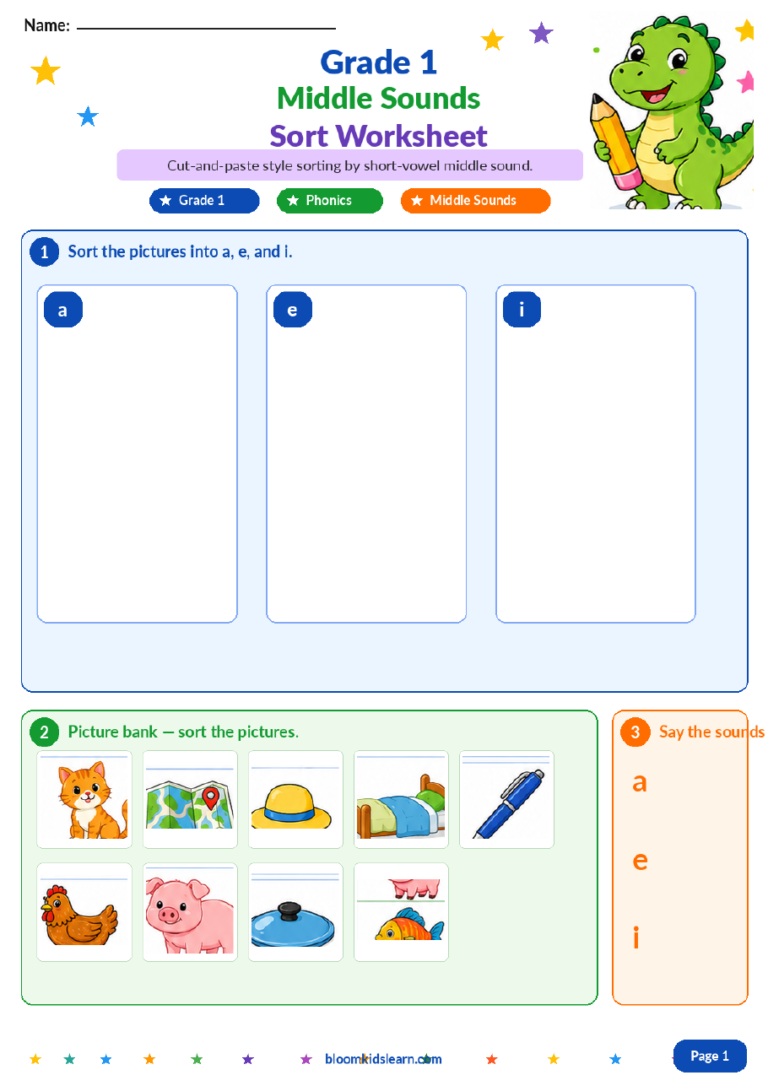
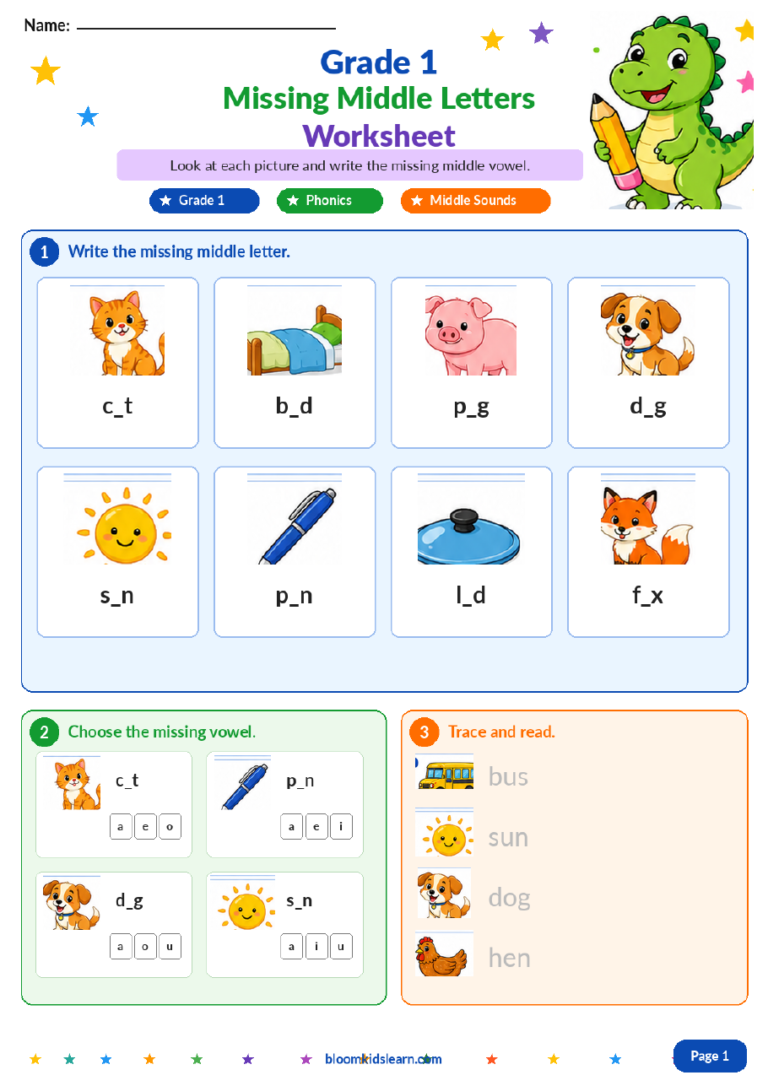
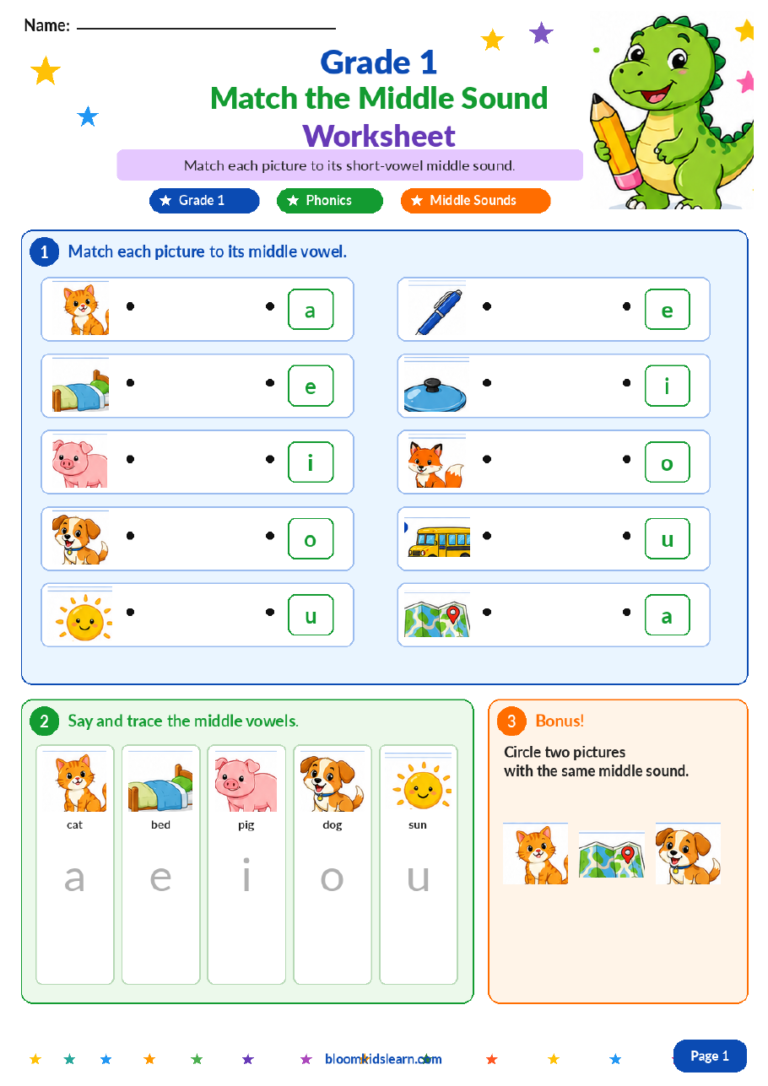
On page 1, children circle the middle vowel in cat, bed, pig, dog, sun, pen, lid, and fox. The alternatives vary by item; for example, cat offers a, e, and i, while dog offers a, o, and u. A second task narrows the choice to two vowels for dog, bed, sun, and pig. The page ends by asking for one word containing each short vowel.
Page 2 continues with hat, hen, fish, log, rug, box, bus, and map. A five-row picture comparison asks the child to circle the word with a given middle sound. The final box removes the printed choices and asks for the middle sounds in cat, hen, fish, and dog.
How to Teach Correct Middle-Sound Choices
Model the decision, not just the answer. For pig, say the word once, then segment /p/ /i/ /g/. Point to the three choices and test them: pag, peg, pig. Only one matches the spoken picture word. Blend the correct word again to confirm it.
Use the same routine with dog and sun. The goal is not to pronounce every possible nonsense form perfectly; it is to show that the vowel changes the word’s center. Once the learner understands, shorten the prompt to: “Say it, stretch it, choose it, read it.”
How to Use This Worksheet
- Name the picture without looking at the vowel options.
- Segment the word into beginning, middle, and ending sounds.
- Repeat the middle sound by itself.
- Compare the printed vowel choices.
- Circle the matching letter and blend the completed word.
- Ask the child to explain one or two answers: “I chose o because I hear /o/ in dog.”
To reduce difficulty, cover one distractor or use two vowel cards. To extend the task, ask the child to change the vowel and read the new word when it makes a real word, such as pig to peg.
How Does This Worksheet Help Grade 1 Students?
Multiple-choice work sits between matching and independent spelling. It reduces handwriting but still requires a comparison among possible sounds. The learner cannot rely on a line already pointing to the answer. The “explain your choice” prompt also helps an adult tell the difference between true sound discrimination and lucky guessing.
Common Mistakes and How to Help
The nearest or first option is circled repeatedly. Ask for the middle sound before the child looks at the letters. Move the choice cards into a different order during oral practice so position cannot become the strategy.
The child says the vowel name. Return to the word: /d/ /o/ /g/, not “dee-oh-gee.” Contrast the sound heard in the word with the letter name used to label it.
Two vowels sound almost the same. Use direct contrast practice with clear, familiar words. Short e and short i may need a small set such as hen/pig and bed/lid before returning to all five vowels.
The picture is misnamed. Supply the intended word. A picture of a rug called a “mat” changes the vowel, so agree on the word before evaluating the phonics response.
What Should Your Child Practice Next?
Move to the Missing Middle Letters Worksheet when the learner can choose accurately and is ready to recall the vowel without options. For an easier review, use the Middle Sound Matching Worksheet. All five resources are linked on the Middle Sounds Worksheets for Grade 1 hub.
Frequently Asked Questions
How can Grade 1 students identify the correct middle vowel?
They should say the picture word, segment it into three sounds, repeat the second sound, and then connect that sound to its vowel letter. Blending the completed word provides a final check.
Why do children confuse short vowel sounds?
Short vowels are brief and occur between consonants, so they can be less noticeable than the word’s edges. Some pairs, especially short e and short i, may require direct oral comparison.
Should children say the word aloud before choosing a vowel?
Yes. The task depends on hearing the spoken word. Naming and stretching it prevents the child from treating the printed choices as a visual guessing exercise.
How can I tell whether a child is guessing?
Ask the learner to say the middle sound and explain one choice. A correct answer without a consistent explanation may need to be checked with a similar word in a different layout.
 Preview