
Missing Middle Letters Worksheet for Grade 1
Complete picture-supported CVC words by hearing and writing the missing medial vowel, then correct words with an inaccurate vowel.
- Skill: Write missing middle vowels in picture-supported CVC words
- Learning goal: Segment a familiar CVC word, identify the medial vowel phoneme, and write the matching vowel letter.
- Format: Printable PDF worksheet
- Answer key: Separate PDF available
 Download Worksheet PDF
 View Answer Key
In c_t, the consonants give useful clues, but the word is not complete until the learner hears and records /a/. This missing middle letters worksheet for Grade 1 moves beyond recognition: children say a picture word, isolate its medial vowel, and write the letter that completes the CVC pattern.
Download and Print the Missing Middle Letters PDF
Use the supplied middle sounds answer guide to check the listed core words. The guide does not list every extension response, so accept another correctly spelled short-vowel word where the worksheet invites an original answer.
What Does This Grade 1 Worksheet Practice?
This activity practices phoneme segmentation, short-vowel identification, and early spelling. A learner must hold the whole word in mind, pull apart its sounds, and represent the middle phoneme with a letter. That is a larger step than matching because the vowel is recalled rather than copied.
The pictures keep the vocabulary familiar while the letter frames focus attention on position. Words include cat, bed, pig, dog, sun, pen, lid, fox, map, hat, rug, log, bus, hen, box, and fish. Most are three-phoneme words; fish still has three phonemes because sh represents one ending sound.
What’s Included in This Worksheet?
Page 1 opens with eight picture words missing their middle vowel: c_t, b_d, p_g, d_g, s_n, p_n, l_d, and f_x. A smaller multiple-choice section asks children to choose the vowel for cat, pen, dog, and sun. The page finishes with tracing and reading for bus, sun, dog, and hen.
Page 2 adds map, hat, rug, log, bus, hen, box, and fish. The “Fix the word” activity is particularly useful: the picture shows the intended word, while an incorrect vowel creates cot, dig, sen, or peg. Children replace the medial vowel to make cat, dog, sun, and pig. A final box asks for the vowels in mug, fox, hat, and rug.
How to Teach Missing Middle Vowels
Use three sound boxes. Say dog and push one counter into each box for /d/, /o/, and /g/. Point to the middle box and ask what was heard there. Then write d_g and let the child add o. This separates the listening step from the handwriting step.
Model one example and think aloud briefly: “The picture is a dog. I hear /d/ /o/ /g/. The middle sound is /o/, so I write o.” On the next item, prompt with questions instead of giving the vowel. Gradually remove the counters once the child can segment reliably.
How to Use This Worksheet
- Preview the pictures and agree on each word.
- Say the word aloud and stretch its three sounds.
- Point to or tap the middle sound.
- Write the vowel in the blank.
- Blend the completed word from left to right.
- For “Fix the word,” read the incorrect form, compare it with the picture, and change only the vowel.
A learner who needs support can use vowel cards and place the correct card in the gap before writing. For a stronger learner, cover the pictures after completion and dictate six words in a new order.
How Does This Worksheet Help Grade 1 Students?
Writing a missing vowel links speech to print. It also shows whether the child can keep the beginning and ending sounds stable while changing the middle. The correction task makes this relationship visible: changing one letter turns cot into cat or dig into dog. That same flexibility supports decoding, spelling, and later word-family work.
Common Mistakes and How to Help
The vowel is left blank. The child may be looking at the letters without segmenting the spoken word. Return to counters or finger taps and ask for the second sound before asking for a letter.
The correct sound is spoken but a different letter is written. This points to sound-to-letter mapping, not a listening failure. Show two vowel cards, say the sounds, and let the learner select before copying.
Short e becomes short i. Compare a few picture pairs such as hen/pig and pen/lid. Keep the words short and familiar. Pronunciation varies, so use the child’s normal spoken word as the starting point and model the target classroom spelling clearly.
The child changes a consonant too. Cover the first and last letters and ask, “Which one space are we fixing?” Then uncover the word and blend it again.
What Should Your Child Practice Next?
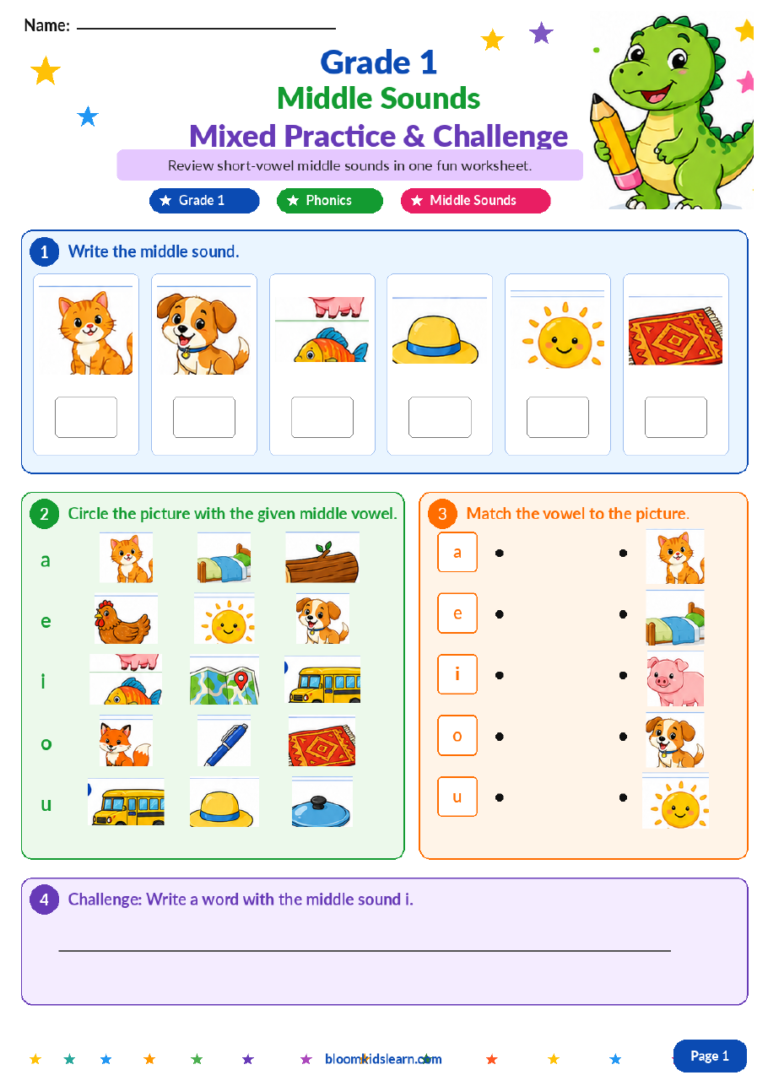
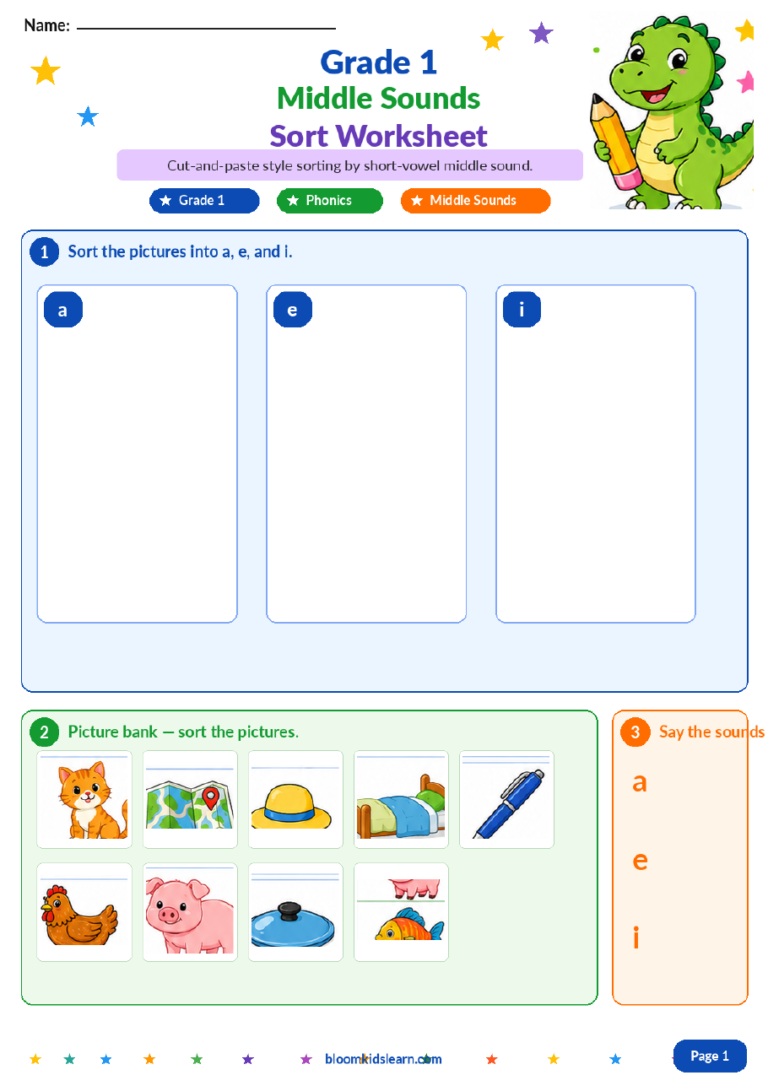
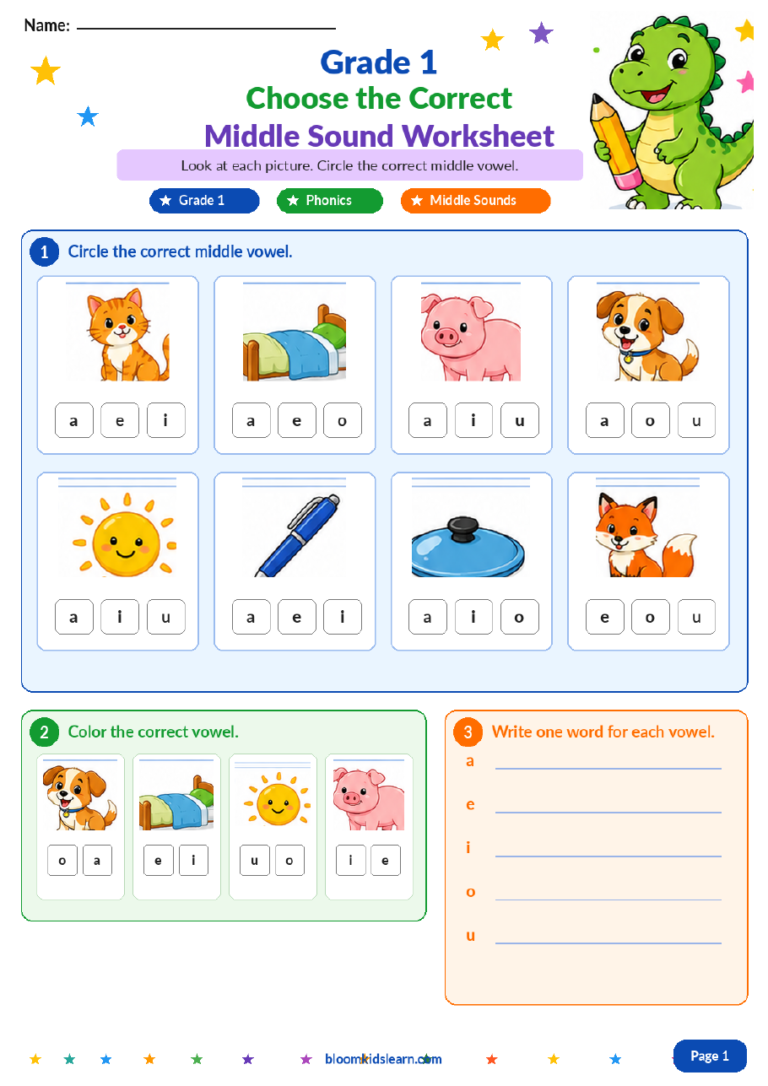
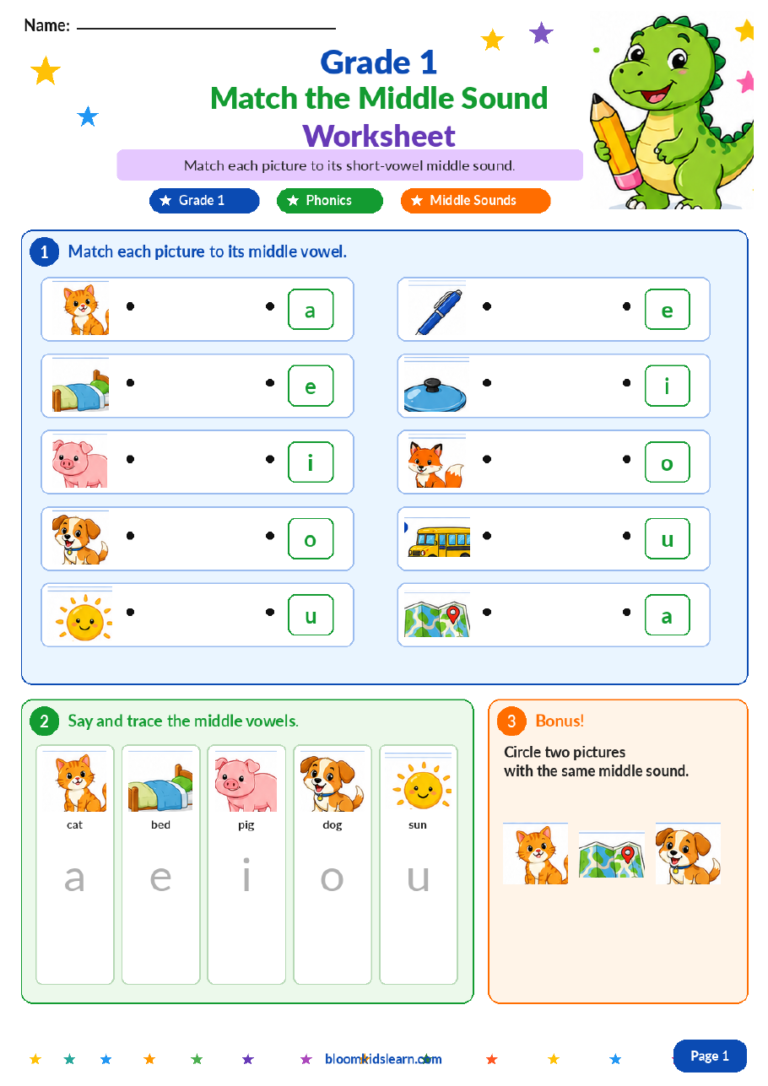
Continue with the Middle Sounds Sort Worksheet, where words must be compared across vowel groups. If recall is not yet secure, step back to the Choose the Correct Middle Sound Worksheet. The Middle Sounds hub organizes every page, and the Grade 1 CVC word worksheets provide the later reading progression.
Frequently Asked Questions
How do you teach missing middle vowels in CVC words?
Say the word, segment it into three phonemes, identify the second phoneme, and then write the matching vowel. Sound boxes or three finger taps make the middle position easier to notice.
Why does my child leave vowels out when spelling?
The child may be recording the more noticeable consonants first and not yet isolating the medial sound. Oral segmentation before writing usually gives clearer information than asking the child to copy the word repeatedly.
What if my child hears the vowel but writes the wrong letter?
Practice the connection between that sound and its grapheme. Use two or three vowel cards, let the child select the letter, and then write it in the word.
When is a Grade 1 learner ready for missing-middle-letter practice?
Begin when the learner can say familiar CVC picture words and usually identify the middle sound with choices. If independent recall causes constant guessing, return briefly to matching or multiple-choice work.
 Preview