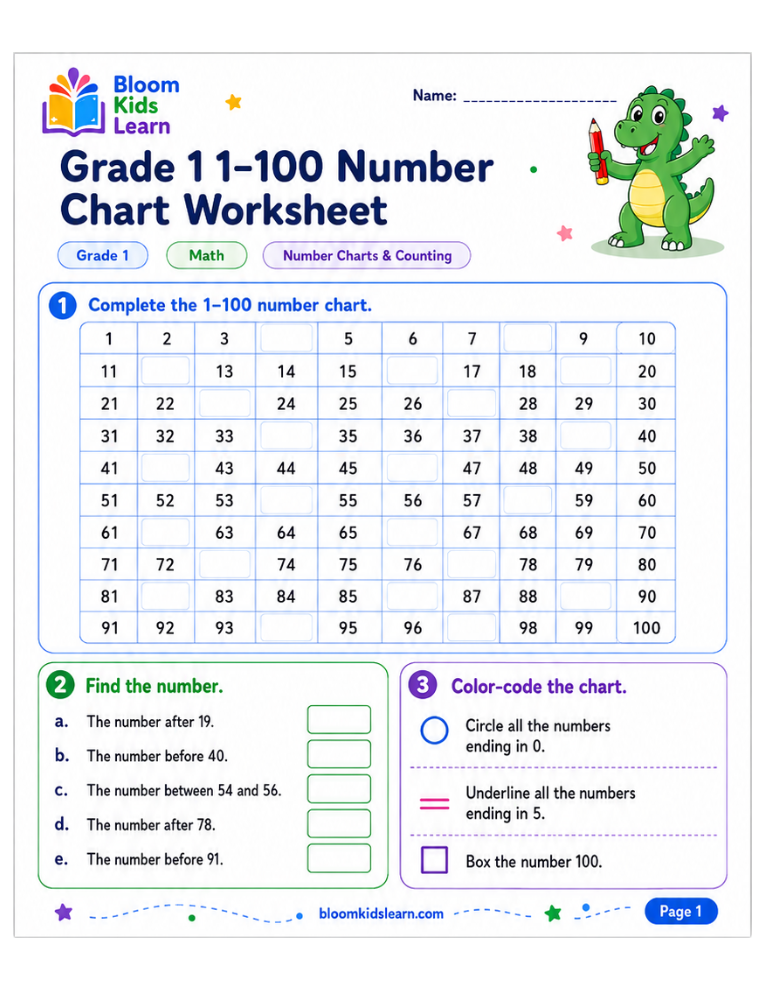

Number Chart Basic Practice Worksheet for Grade 1
- Skill: Read and complete number charts from 1 to 40
- Learning goal: Complete simple number charts and solve before, after, and between clues.
- Format: Printable PDF worksheet
 Download Worksheet PDF
This number chart worksheet for Grade 1 gives children a friendly first look at numbers in order. The printable uses short 1-10, 11-20, 21-30, and 31-40 charts before moving into reading rows, finding what comes next, and locating a number from a clue. The page is useful for a math center, morning work, tutoring, homeschool practice, or a short home lesson.
Children do not need to finish quickly. Encourage them to point, say each number, and check a blank by looking at the numbers on both sides. That simple routine builds number sense and helps learners understand why an answer belongs in a box.
Number Chart Worksheet Grade 1: Skills Covered
- Read and write numerals from 1 to 40.
- Complete short sections of a hundred-chart pattern.
- Count forward one number at a time.
- Find the number before, after, or between two clues.
- Use rows to keep numbers in the correct order.
- Explain an answer with neighboring numbers.
Learning Objective
After working through this Grade 1 number chart worksheet, the learner will complete simple chart gaps and use one-more and one-less language to solve number clues. The activity prepares children for a full 1-100 chart and later place-value work.
What is on the printable?
Section 1 contains four mini charts. In each grid, a few numerals are missing, so the child completes a familiar sequence without facing a crowded full page. Section 2 provides rows such as 1, 2, 3, 4, 5 and asks the learner to write the numbers in order. Section 3 asks what number comes next in several short patterns. Section 4 uses clues such as “after 14,” “before 27,” and “between 18 and 20.” Together, the sections move from recognition to independent reasoning.
How to teach with a number chart
Start with a quick oral warm-up. Point to 1 and ask the child to count to 10. Then point to 11 and continue to 20. If a blank appears in the chart, cover it with a finger and ask, “What number comes after the one you can see?” Let the learner say the sequence before writing. A small number line, counters, or a row of blocks can provide support without giving away every answer.
For the mini charts, solve the first blank together and explain the rule. In a row that reads 11, 12, 13, blank, 15, the missing number is 14 because it is one more than 13 and one less than 15. Ask the child to check both sides of the box. This two-way check is more reliable than guessing from memory.
Worked examples
Complete a chart
If the row is 21, blank, 23, 24, the answer is 22. Read the full row aloud after writing it: 21, 22, 23, 24.
Find what comes next
For 35, 36, 37, the next number is 38. The pattern adds one each time.
Use a clue
If the question asks for the number between 18 and 20, the answer is 19. The word “between” means the number in the middle.
Common mistakes and helpful prompts
Some children skip a number when they move from 9 to 10 or from 19 to 20. Slow down at the transition and let them touch each printed numeral. Others reverse digits, such as writing 31 when the chart needs 13. Ask the child to read the number aloud and compare its place in the row. If a learner writes 17 after 15, point to 16 and ask what number was skipped.
Differentiation and extension
For support, complete only one mini chart at a time and highlight the starting number. Provide a 1-20 strip, then cover part of it as confidence grows. For extension, ask a child to write three new clues for a partner: one number after, one before, and one between. A learner who is ready for more can continue each row to 50 or build a small chart that starts at a number other than 1.
Answer guidance
Check answers by reading each row from left to right. A correct blank must fit the count-by-ones pattern and agree with the clue. Invite the learner to explain one answer using a sentence such as, “I wrote 28 because 28 comes after 27 and before 29.” If an answer is incorrect, return to the closest known number and count forward rather than erasing the whole section.
Use at home or in class
Print the page on US Letter paper and keep a pencil, eraser, and optional number line nearby. A ten-minute session is enough for most learners. Place the finished page in a math folder and revisit it later in a dry-erase sleeve. Reusing the printable lets children focus on explaining patterns instead of racing through new questions.
Related practice and standards
For a complete 1-100 chart, continue with our Number Charts & Counting worksheets. Children who need more consecutive-number practice can use the Counting by 1s collection. Learners ready to make equal jumps can try Counting by 10s worksheets. The activity connects with the official Grade 1 counting expectation.
FAQ
What grade is this worksheet for?
It is designed for Grade 1 and also works for kindergarten enrichment or Grade 2 review.
Can children use a number chart?
Yes. Use a chart as a scaffold then ask the learner to solve one row without looking.
How long should practice take?
Ten to fifteen focused minutes is usually enough. Accuracy and explanation matter more than speed.
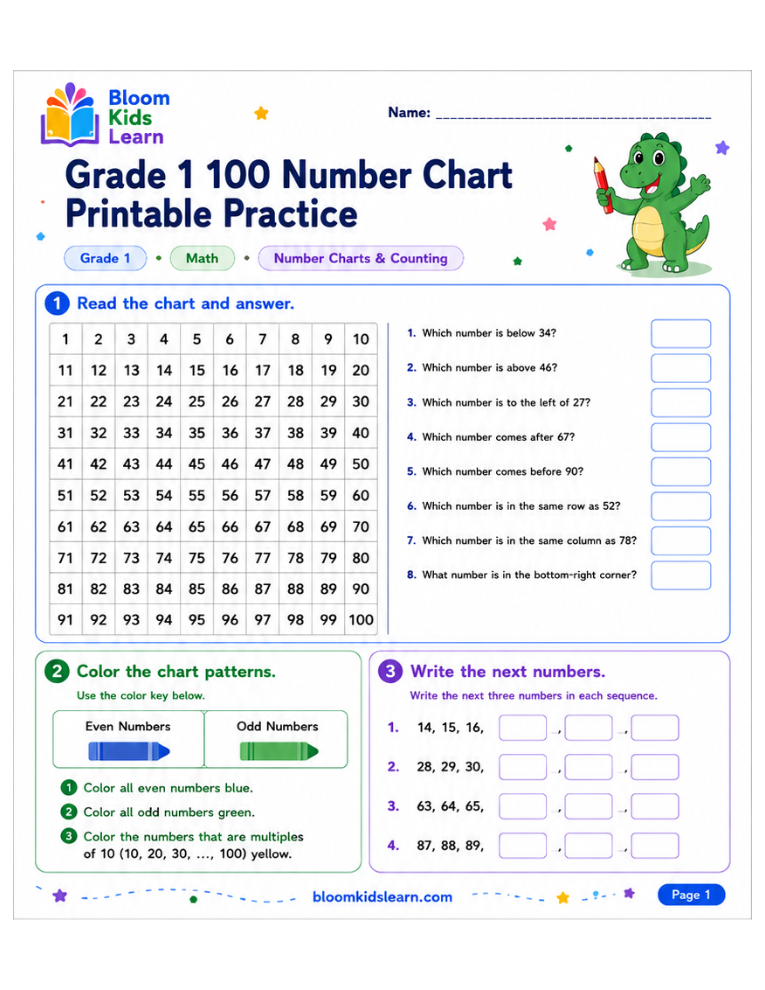
 Preview