Number Words Challenge Worksheet for Grade 1
- Skill: Number-word reading, spelling, sequences, and clue solving
- Learning goal: Apply number words from 1 to 20 in independent Grade 1 challenge tasks.
- Format: Printable PDF worksheet
 Download Worksheet PDF
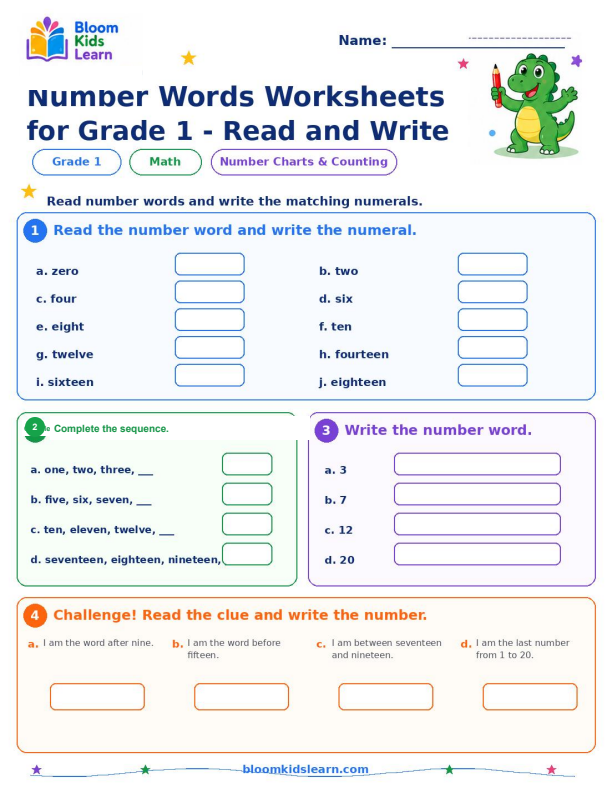
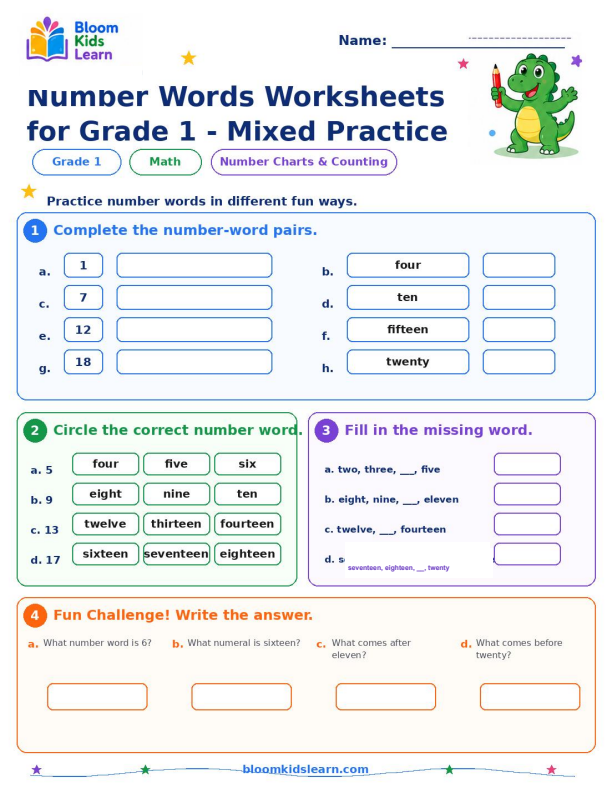
This free number words challenge worksheet for Grade 1 gives children a focused final review of number names from one to twenty. Instead of repeating one routine, the page asks learners to read clues, convert numerals into words, complete missing parts, and explain which number belongs in a sequence. It works well after the Number Words Mixed Practice worksheet and can also be used as a short assessment before moving on.
Number Words Challenge Worksheet Skills
Students practice reading, spelling, and applying number words in several formats. The challenge page is designed for independent Grade 1 work, but an adult can read the directions aloud and let the child explain each answer.
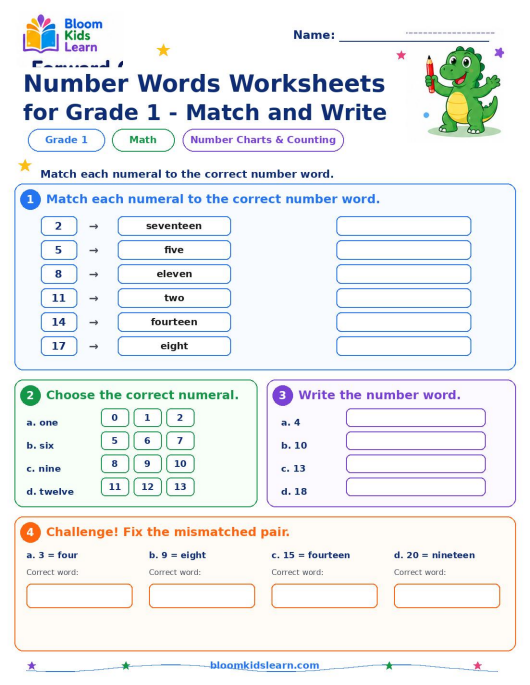
- Match numerals and number names from 1 to 20.
- Spell common number words accurately, including eleven, twelve, thirteen, fifteen, and twenty.
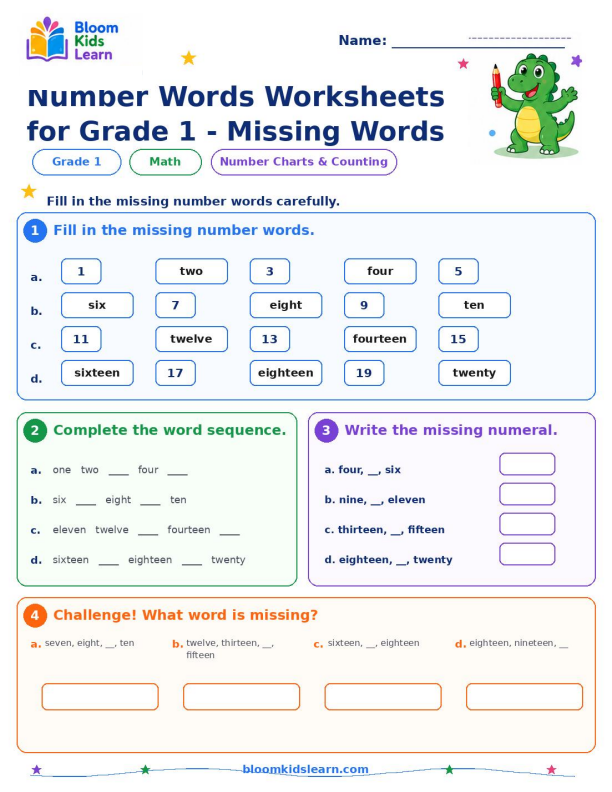
- Use counting order to identify a missing word.
- Read a clue and write either the numeral or its number name.
- Check an answer by counting forward or backward.
Grade 1 Learning Objective
After completing this printable, a learner should be able to move between a numeral and its written name and use number-word order to solve an unfamiliar clue. The goal is accurate mathematical vocabulary, not speed. Encourage the child to say the answer, write it neatly, and reread the word before moving on.
How to Use This Printable
Begin with a one-to-twenty number line or a small stack of numeral cards. Ask the learner to read each number aloud, then hide the cards and start the worksheet. For the first items, model how to locate the numeral, say the quantity, and write the matching word. For a sequence, read every word from the beginning; the missing word is usually easier to hear when the whole pattern is spoken. Save the final clue section for quiet independent practice.
Worked Examples
If the clue gives the numeral 14, the answer is fourteen. If a sequence reads “sixteen, seventeen, __, nineteen,” the missing word is eighteen. When the clue asks what comes after twelve, count one step forward to find thirteen. For a spelling check, compare fifteen with the incorrect form “fiveteen” and listen for the syllables.
Common Mistakes and Helpful Prompts
Children often reverse the order of letters in fourteen or confuse forty with fourteen. Ask, “Which number are you saying?” rather than supplying the answer. Teen words can also be mixed up when a child relies on the first letter alone. Have the learner point to the numeral, say it slowly, and use a reference strip only after making an honest attempt. Remind them that twenty ends with ty, while teen numbers end with teen.
Differentiation and Extension
For support, cover half the page and offer a number-word chart from one to twenty. Let the learner trace a difficult word once, then write it independently. For extension, ask the child to create three clues for a partner: one “before” clue, one “after” clue, and one missing-word sequence. A confident learner can sort the answers into single-digit numbers, teen numbers, and twenty and explain the pattern.
Answer Guidance
Check each answer against the counting sequence and the spelling of the number name. Accept a carefully corrected self-edit when the original attempt is crossed out clearly. If an answer is wrong, return to the numeral and ask the learner to say the number before rewriting it. A quick oral review of one through twenty is often more useful than copying a word repeatedly.
Related Practice and Standards
Use the Number Words Read and Write worksheet for guided conversion and the Number Words Match and Write worksheet for extra matching. The counting by 1s collection reinforces the quantity sequence behind each word. For standards context, see the official Grade 1 Common Core counting and addition language.
FAQs
What grade is this worksheet for?
It is written for Grade 1 and can also support kindergarten enrichment or Grade 2 review.
Should children use a chart?
Use a chart for the warm-up or support section, then remove it for the challenge clues.
Is the file ready to print?
Yes. Open the worksheet details panel and print the PDF on US Letter paper.
How to Read the Clues
Encourage the learner to underline the important word in each clue: before, after, between, or more than. Those words tell the child which direction to move in the counting sequence. If a clue feels difficult, turn it into a short spoken sentence first. For example, “two more than eighteen” can become eighteen, nineteen, twenty.
Practice Beyond the Page
Keep the number-word work going with quick real-life prompts. Ask a child to write the number of crayons on a table, label a page with today’s date, or put three cards in counting order. These small moments connect spelling to quantities and make the written words easier to remember.
Careful Self-Checking
A completed challenge deserves a final read-through. Have the learner say each numeral, spell each word slowly, and check that every sequence moves one step at a time. Correcting one answer independently is useful evidence of understanding, even when the first attempt was not perfect.
 Preview