
Number Words Read and Write Worksheet for Grade 1
- Skill: Read number words, write numerals, and spell number names
- Learning goal: Read and write number words from zero through twenty and continue word sequences.
- Format: Printable PDF worksheet
 Download Worksheet PDF
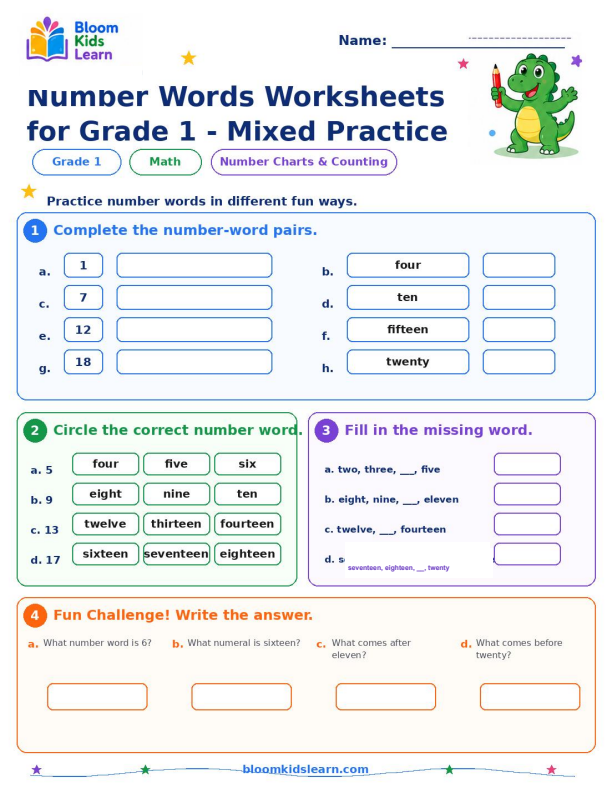
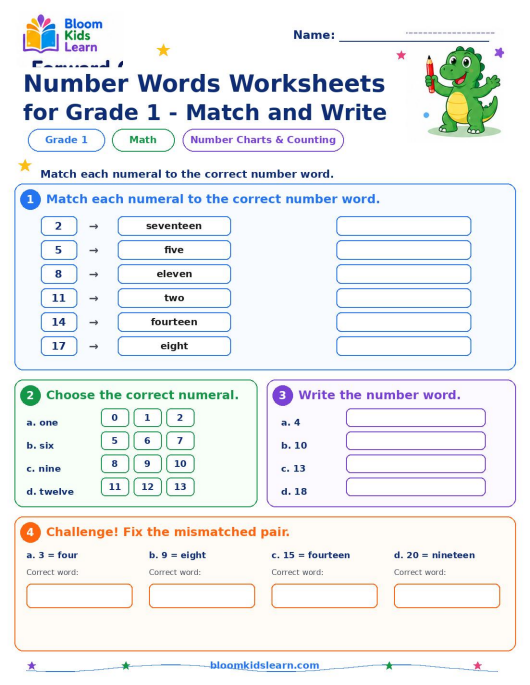
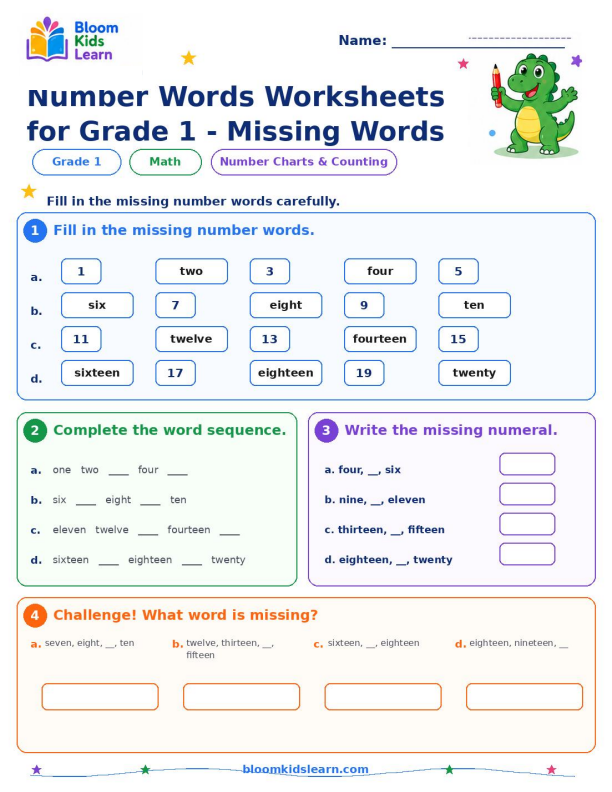
This free number words read and write worksheet for Grade 1 gives children focused practice reading number names and converting them into numerals. Learners read words from zero to eighteen, complete counting sequences, write number words for given numerals, and solve short clues. The page is useful for a math center, classroom review, tutoring, homework, or homeschool practice.
Number Words Read and Write Worksheet: Skills Covered
The first section asks students to read words such as zero, two, four, six, eight, ten, twelve, fourteen, sixteen, and eighteen, then write each matching numeral. The second section asks what comes next in sequences such as one, two, three, __. The third section reverses the task: children see 3, 7, 12, and 20 and write the number words. A final challenge uses clues such as “the word after nine” or “the last number from 1 to 20.”
- Read number words from 0 to 20.
- Write numerals for written numbers.
- Continue an ordered number-word sequence.
- Spell number names clearly and accurately.
- Use counting order to solve a clue.
Grade 1 Learning Objective
After completing this printable, a learner should be able to read a number word, write its numeral, and move confidently between a written number and its word form. The worksheet connects math vocabulary with counting and supports careful writing in early Grade 1 lessons.
How to Teach With This Page
Begin by counting aloud from zero to twenty. Show a numeral and ask the child to say it before revealing the word. For the first section, encourage the learner to underline the key word and write the numeral slowly. In the sequence section, have the child say the list aloud and identify the next number before writing. For section three, let the child stretch each word, listen for its sounds, and check the spelling against a reference strip.
Worked Examples
The word zero matches 0, and eight matches 8. In the sequence “one, two, three, __,” the next word is four. If the numeral is 12, write twelve. A clue that says “the word after nine” points to ten, while “the word before fifteen” points to fourteen.
Common Mistakes
Children may write 0 for the word zero but forget that zero still belongs in the counting sequence. Others confuse twelve and twenty or write “fiv” instead of five. Ask the learner to read the full word aloud and compare it with a model. When a sequence includes seventeen, eighteen, and nineteen, emphasize the shared teen ending and ask which beginning syllable changes.
Differentiation and Extension
For extra support, practice only five words at a time and use numeral cards beside a word chart. Let the child trace a model before writing independently. For extension, ask a confident learner to write the number word for 21 or 30 and explain that those words are beyond this page’s focus. Another activity is to write a short riddle: “I am between eleven and thirteen. What word am I?”
Answer Guidance
The first section answers are zero-0, two-2, four-4, six-6, eight-8, ten-10, twelve-12, fourteen-14, sixteen-16, and eighteen-18. The sequence answers are four, eight, twelve, and twenty. The writing answers are 3-three, 7-seven, 12-twelve, and 20-twenty. The challenge answers are ten, fourteen, twelve, and twenty.
Related Number-Word Practice
Use the Number Words Basic Practice worksheet for guided introduction, then review the Number Words Match and Write worksheet for matching and correction. Counting support is available in the counting by 1s collection.
FAQs
Who should use this worksheet?
It is designed for Grade 1, with kindergarten enrichment or Grade 2 review use.
Can a child use a word chart?
Yes. A chart is a helpful scaffold until spelling becomes automatic.
Is the file print-ready?
Yes. Open the PDF from the worksheet details panel and print it on US Letter paper.
Build Confidence With a Word-to-Number Routine
Use the same three steps for each item: read the number word, say the numeral, and write it carefully. Invite the learner to point to the word while speaking so the visual form and the spoken name stay connected. When a spelling looks unfamiliar, compare it with a small number-word strip instead of supplying the answer immediately. This keeps the worksheet a math activity while still supporting early writing skills.
Common Confusions to Notice
Children sometimes reverse a numeral, leave out a letter in three, or confuse fourteen with forty. Ask the learner to place the word in counting order and listen for the ending. A quick oral check—“What comes before it and after it?”—often reveals whether the issue is spelling, number sense, or both. Correct one example together, then let the child try a similar item independently.
Home Practice and Extension
For a short follow-up, write three numerals on scrap paper and ask the child to turn each into a number word. For an extension, mix the words and numerals from 0 to 20 and have the learner match pairs, then explain one match aloud. Keep the finished worksheet as a progress sample and revisit the hardest two words later in the week.

 Preview