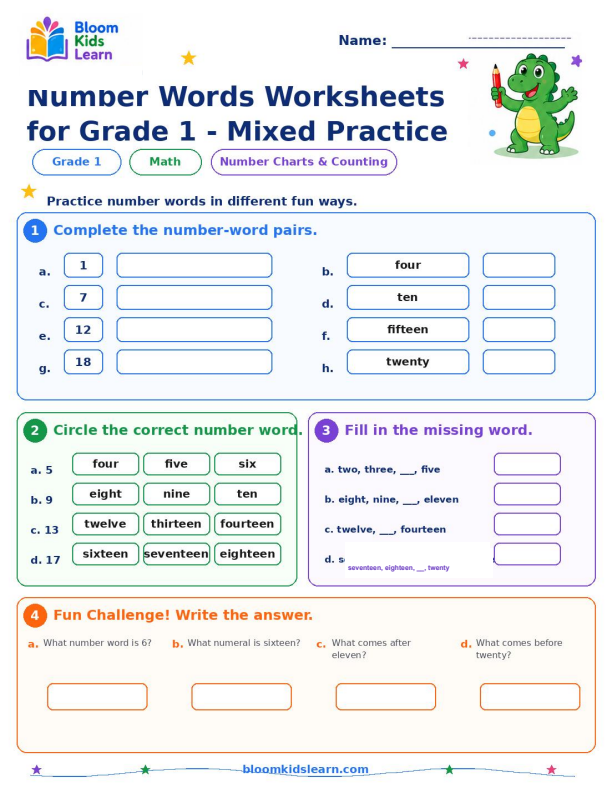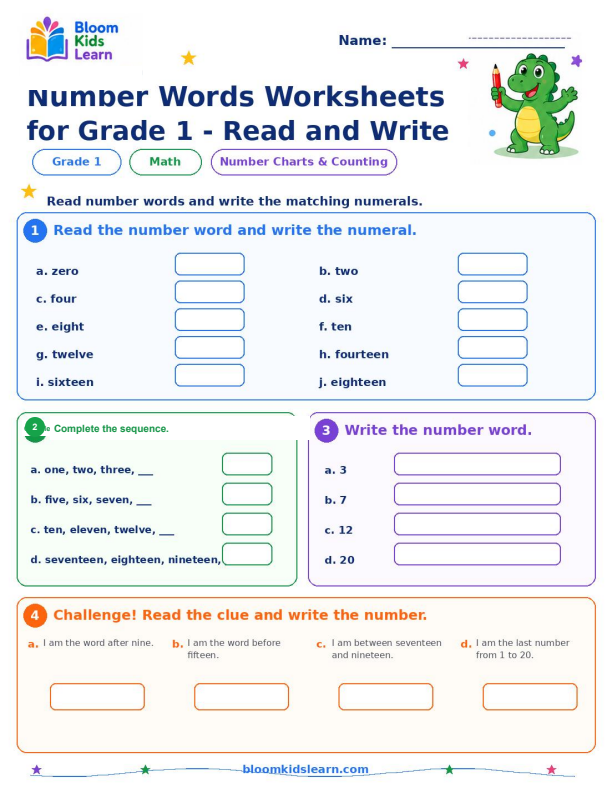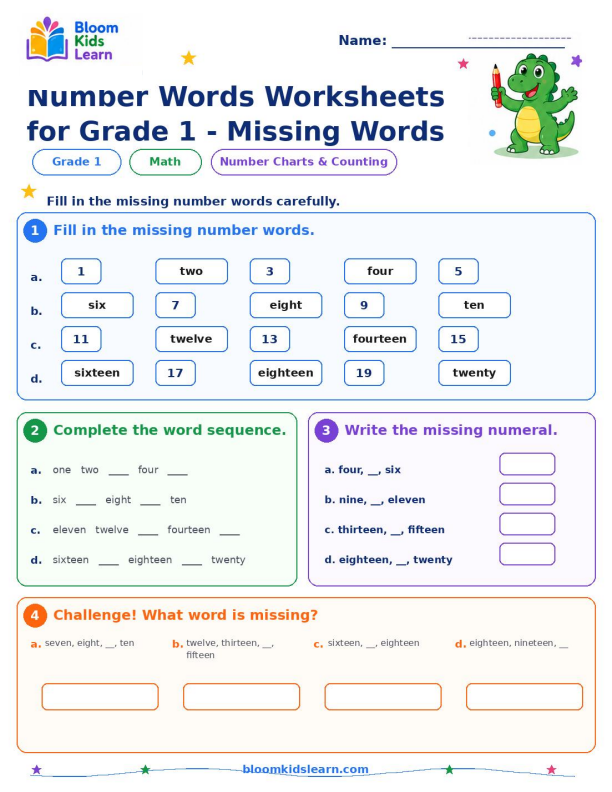

Number Words Match and Write Worksheet for Grade 1
- Skill: Match numerals to number words and write number names
- Learning goal: Match, read, and write number words from one through twenty.
- Format: Printable PDF worksheet
 Download Worksheet PDF
This free number words match and write worksheet for Grade 1 helps children connect numerals, number names, and careful handwriting. Learners match numbers to words, choose the correct numeral for a word, write number words from numerals, and repair mismatched pairs. The varied practice keeps the same math idea fresh while building reading and spelling confidence.
Number Words Match and Write Worksheet: Skills Covered
The first section asks students to match numerals such as 2, 5, 8, 11, 14, and 17 to number words. The second section offers three numeral choices for one, six, nine, and twelve. In the third section, children write the words for 4, 10, 13, and 18. A challenge section presents incorrect pairs such as 3 = four and asks the learner to write the correct word.
- Read numerals from 1 to 20.
- Match number words with equivalent numerals.
- Write number names with clear letter formation.
- Notice when a numeral and word do not represent the same number.
- Use counting order to check an answer.
Grade 1 Learning Objective
After completing this printable, a learner should be able to identify a number word for a given numeral, choose a numeral for a written number, and correct a mismatched pair. The activity strengthens math vocabulary and supports the transition from saying numbers aloud to reading and writing them in words.
Teaching Steps
Start by counting from one to twenty while pointing to a number chart. Show a numeral and ask the child to say it before looking at the word. In the matching section, encourage the learner to draw a light line or use a finger to connect the pair. In the choice section, read all three options aloud. For writing tasks, say the word slowly, invite the child to tap each syllable, and then check spelling after the word is complete.
Worked Examples
The numeral 5 matches five. The numeral 11 matches eleven, while the word twelve matches 12. If the page asks for the number word for 13, write thirteen. In a mismatched pair such as 15 = fourteen, ask which number comes after fourteen; the correct word is fifteen.
Common Mistakes
Children sometimes match by the first letter alone. Explain that four and five both begin with f, so the numeral is the deciding clue. Another common error is confusing eleven and twelve or omitting the h in eight. Ask the learner to compare the word with a reference strip and reread it from left to right. When correcting a pair, remind the child to check the quantity, not only the spelling.
Differentiation and Extension
For support, begin with numerals 1–5 and cover the remaining choices. Use letter tiles to build each word before writing it. For extension, ask a confident learner to create three new mismatched pairs for a partner to fix. A memory game also works well: place numeral cards and word cards face down, then keep only pairs that match. Invite the child to explain the clue used for each match.
Answer Guidance
In the matching section, the correct pairs are 2-two, 5-five, 8-eight, 11-eleven, 14-fourteen, and 17-seventeen. The choices are one-1, six-6, nine-9, and twelve-12. The writing answers are 4-four, 10-ten, 13-thirteen, and 18-eighteen. Correct the challenge pairs to 3-three, 9-nine, 15-fifteen, and 20-twenty.
Related Number-Word Practice
Use the Number Words Basic Practice worksheet for a gentle introduction, then review the Number Words Missing Words worksheet for sequence practice. Counting activities such as the counting by 1s collection help connect each word to an actual quantity.
FAQs
What grade is this for?
This worksheet is written for Grade 1, with use as kindergarten enrichment or Grade 2 review.
Can children use a word chart?
Yes. A chart is a useful scaffold during first practice and can be removed for independent review.
Is it print-ready?
Yes. Open the PDF from the worksheet details panel and print it on US Letter paper.
Use a Simple Matching Routine
Invite the learner to read every number word before drawing a line. Then say the numeral and look for the matching word. Starting with familiar pairs such as 2 and two builds confidence before the child works on longer words. Encourage the learner to cross out a pair only after checking both the value and the spelling. This prevents a quick visual match from becoming a counting mistake.
Support for Tricky Number Names
Words such as three, eight, twelve, and eighteen deserve extra time. Let the child say the word slowly, point to each letter, and compare it with a reference strip. If a numeral is confusing, place it in counting order between two known numbers. For example, 13 comes after 12 and before 14, so its word belongs in that same spot.
Extension and Progress Check
After finishing, write three new numeral-word pairs on cards and ask the learner to mix and match them. For an extension, include one deliberate mismatch and ask the child to explain why it is wrong. Save the page as a progress sample and revisit the two hardest words later. Accurate matching plus a clear explanation shows that the learner understands both the number and its written name.

 Preview