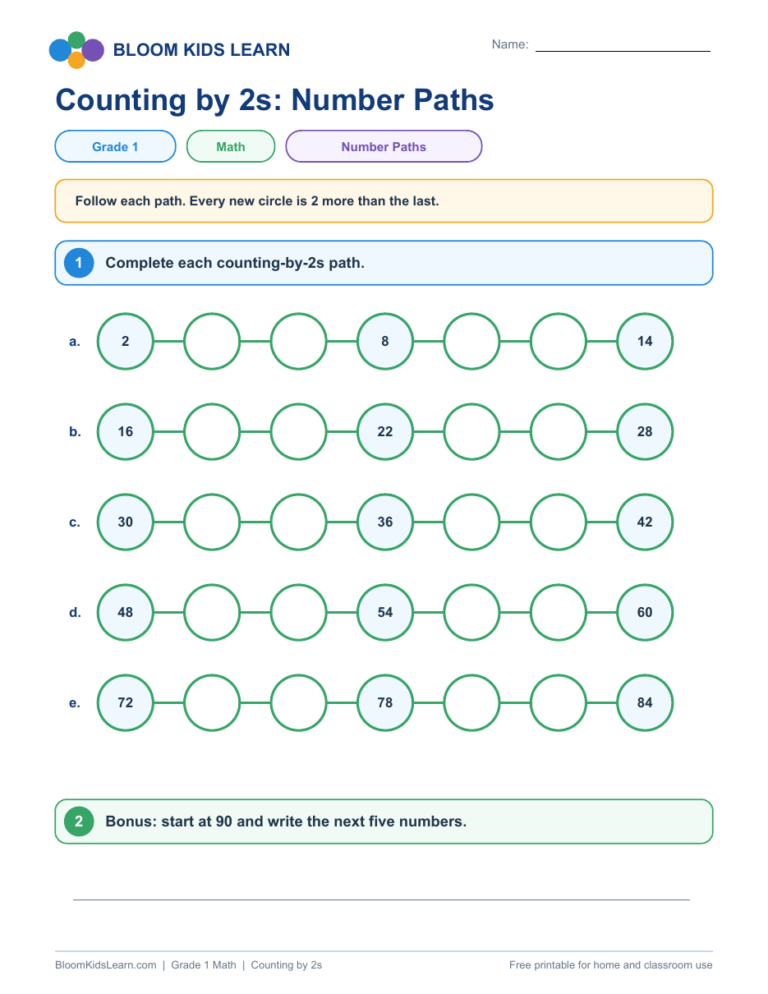

Counting by 2s Missing Numbers Worksheet for Grade 1
Practice skip counting with a free Grade 1 counting by 2s missing numbers worksheet featuring sequence blanks and next-number questions within 100.
- Skill: Complete counting-by-2s sequences within 100
- Learning goal: Use neighboring numbers to find missing values in sequences that increase by 2.
- Format: Printable PDF worksheet
 Download Worksheet PDF
Counting by 2s is easier when children learn to look at the numbers on both sides of a blank. This free Grade 1 counting by 2s missing numbers worksheet gives students focused practice with that strategy. The printable page begins with short sequences in which some numbers are already provided, then ends with five “what comes next?” questions. Every sequence moves forward by 2, so children can practice identifying the rule, checking their work, and becoming more fluent with even-number patterns.
Download the PDF: Grade 1 Counting by 2s Missing Numbers Worksheet
What children practice on this worksheet
The first section contains five number rows. Children fill each blank by adding 2 as they move from left to right. The rows include sequences such as 0, 2, 4 and continue through larger two-digit numbers, giving students a gradual increase in challenge without changing the counting rule. The second section asks children to write the number that comes next after a three-number pattern. These short questions are useful for checking whether a child recognizes the rule independently rather than simply copying a long row.
- Count forward by 2 within 100.
- Use neighboring numbers to find a missing value.
- Recognize the pattern made by even numbers.
- Continue a sequence from a number other than 2.
- Write numerals clearly in small answer spaces.
How to teach the missing-number strategy
Before handing over the page, model one short example aloud. For the pattern 12, 14, blank, 18, explain: “I add 2 to 14, so the missing number is 16. I can check by adding 2 again: 16, 18.” That final check is important because it teaches children to use both sides of a blank. When only one neighboring number is visible, they can count forward by 2. When the blank sits between two known numbers, they can check that it is 2 more than the number before it and 2 less than the number after it.
Encourage the child to say the sequence quietly while writing. Hearing “30, 32, 34, 36” connects spoken counting with printed numerals. If counting by 2s is still new, let the child point to a number line or make pairs with counters. Remove that support once the pattern becomes comfortable. The goal is accurate reasoning first and quicker recall later.
A simple lesson plan for home or school
- Warm up for two minutes. Count aloud by 2s from 0 to 20. Repeat once while tapping or clapping on each number.
- Model one row. Complete a short sequence together and show how to check a blank from both directions.
- Complete the printable. Ask the child to work one row at a time. Pause only when the pattern breaks down.
- Review mistakes. Circle the number before an incorrect answer, add 2, and try the blank again.
- Finish orally. Choose a starting number from the page and ask for the next three numbers without writing.
Most students can use this as a short independent practice activity after a teacher or parent has introduced skip counting. It also works well in a math center, for morning work, or as a quick home review. Avoid turning the page into a speed test. A steady child who can explain why a number belongs in the blank is building stronger understanding than a child who rushes through a memorized chant.
Common mistakes and helpful corrections
A child may add 1 instead of 2, especially after working on regular counting. Point to two consecutive jumps on a number line and say each landing number. Another common error is reversing the digits in numbers such as 32 or 52. Ask the child to read the completed row aloud; the spoken pattern often makes a reversed numeral easier to notice.
Some children restart at 2 whenever a new row begins. Remind them that the rule is “add 2,” not “always begin at 2.” Cover the rest of the row, circle its starting number, and ask, “What is 2 more than this number?” If a student loses track on a longer row, place a small dot under every known number and move a finger from one position to the next while counting.
Differentiate the activity
For extra support, complete the first two blanks together and provide a printed number line. You can also let the child draw two dots above each jump to make the increase visible. For a student who is ready for more, cover one of the printed clues and ask them to reconstruct the entire row. Another useful extension is to choose an odd starting number, such as 1 or 7, and count forward by 2. The numbers will remain odd, which opens a simple conversation about repeating number patterns.
After the page is complete, ask the child to create a four-number sequence with one blank for an adult or classmate to solve. Creating a correct puzzle requires the child to hold the rule in mind and is an effective check for understanding.
Answer guidance
Check each row by reading from left to right and confirming that every number is exactly 2 greater than the previous number. In the final section, the next numbers are 14, 30, 52, 76, and 100. If an answer is incorrect, return to the last printed number rather than supplying the solution. Ask the child to add 2 and then check whether the following number still fits.
Standards and learning context
Grade 1 students are expected to develop flexible understanding of the counting sequence and the base-ten number system. Counting by 2s is useful preparatory work for recognizing patterns, grouping equal sets, and later learning repeated addition. It should complement—not replace—practice counting by ones and explaining how numbers are related.
Keep learning
If the child needs a gentler introduction, begin with the Counting by 2s Basic Practice Worksheet. You can browse the complete Counting by 2s worksheet collection for the next activity. Children who still pause between consecutive numbers may benefit from the Counting by 1s worksheets before returning to skip counting.
Frequently asked questions
Should a Grade 1 student memorize counting by 2s?
Fluency is helpful, but understanding comes first. Let children use objects, spoken counting, and number lines until they can explain that each new number is 2 more.
Is an answer key included?
A separate answer-key file is not required for this page. Adults can check it by adding 2 across every row, and the five final answers are listed in the answer guidance above.
Can I print the worksheet more than once?
Yes. Reprint it for personal classroom or home learning. On a second attempt, invite the child to work with fewer supports and explain one completed row aloud.

 Preview