Counting by 2s Worksheet: Count and Write for Grade 1
Count objects in pairs, write totals, and complete number sequences with this free Grade 1 counting by 2s Count and Write worksheet.
- Skill: Count objects in pairs and continue sequences by 2
- Learning goal: Count equal pairs, write totals, and complete counting-by-2s patterns within 48.
- Format: Printable PDF worksheet
 Download Worksheet PDF
This free Grade 1 counting by 2s count and write worksheet helps children connect groups of real objects with written number sequences. Students first count colorful dots in pairs and record each total. They then write the next three numbers in skip-counting patterns, complete missing-number rows, and finish two short challenges. The page moves from visual groups to abstract numerals.
Download the printable PDF: Grade 1 Counting by 2s Count and Write Worksheet
What children do on this worksheet
The first activity shows five rows containing 4, 6, 8, 10, and 12 dots. The worksheet labels these quantities as 2, 3, 4, 5, and 6 pairs, and students write the total for each row. This makes the meaning of counting by 2s visible: every new pair adds two more objects.
The second activity gives starting numbers 6, 14, 22, 30, and 38. Children write the next three numbers after each start. The third activity uses four missing-number sequences with clues on both sides of each blank. Finally, the challenge asks students to begin at 8 and 32 and write five more numbers by adding 2 each time.
- Count equal groups of two objects.
- Match a number of pairs to the correct total.
- Continue counting-by-2s sequences from different starts.
- Use neighboring clues to find missing numbers.
- Write even numbers clearly and in the correct order.
How to introduce counting in pairs
Begin with a small set of familiar objects such as socks, crayons, blocks, or counters. Place two objects together and say, “One pair makes 2.” Add another pair and say, “Two pairs make 4.” Continue until the child can see that every new group adds exactly two objects. Touch each pair once while saying the running totals: 2, 4, 6, 8, and so on.
Model the first worksheet row before the child begins. Circle or point to the two groups of two dots. Count the groups by 2s—2, 4—and write 4 in the answer box. Explain that counting each dot by ones would also reach 4, but counting the pairs by twos is quicker and shows the number pattern.
A practical lesson routine
- Build pairs. Arrange 12 counters into pairs and count the totals aloud from 2 to 12.
- Complete the visual section. Ask the child to point to each pair once and write the total.
- Move to written sequences. Use the final total in one row as a starting number and add 2 mentally.
- Check missing numbers. Read each completed row aloud and listen for a jump that is not exactly 2.
- Try the challenges. Cover any number line and encourage the child to continue from 8 and 32 independently.
This routine works well for a short whole-group lesson, math center, intervention session, homework task, or home practice. Children may use counters for the first section and remove them for the later sections. That gradual change helps the worksheet assess growing independence without asking a child to abandon visual support too early.
Worked examples
For the row labeled “3 pairs,” count 2, 4, 6. The total is 6 because three groups of two contain six objects. For a written sequence that starts at 14, think “14 plus 2 is 16, plus 2 is 18, plus 2 is 20.” Write 16, 18, and 20 in the three boxes.
For the pattern 2, 4, blank, 8, blank, 12, add 2 after every printed number. The missing values are 6 and 10. Check from right to left as well: 10 is 2 less than 12, and 6 is 2 less than 8.
Common mistakes and helpful corrections
A child may count every dot by ones and lose track before reaching the total. Lightly circle each pair or slide a finger under two dots at a time. The goal is not to forbid counting by ones; it is to help the learner recognize a more efficient grouping strategy.
Some students write the number of pairs instead of the number of objects. If a row has four pairs, ask, “How many dots are in one pair?” Then count 2, 4, 6, 8 and record the total 8. Another common mistake is restarting at 2 when a sequence begins at 22 or 38. Circle the provided starting number and repeat the rule: begin here and add 2.
If a learner adds 1 instead of 2 in the written sections, let them say the hidden number between two answers. For example, after 30 comes 31 and then 32, so 32 is two counts after 30. A number line can make this jump visible until mental counting becomes secure.
Differentiate and extend the practice
For extra support, cut a strip of paper to reveal one activity at a time, provide counters, and complete the first answer in each section together. Let a child speak answers while an adult records one row if handwriting effort is interfering with the math.
For an extension, ask the student to draw seven or eight pairs and write the totals 14 or 16. A confident learner can create a new sequence beginning at an odd number such as 5. Adding 2 will produce 7, 9, 11, and 13, showing that the same rule can create an odd-number pattern. Another extension is to count the completed even-number sequence backward by 2.
Answer guidance
In the pairs section, the totals are 4, 6, 8, 10, and 12. The next-three-number answers are 8, 10, 12; 16, 18, 20; 24, 26, 28; 32, 34, 36; and 40, 42, 44. The missing-number answers are 6 and 10; 16 and 20; 30 and 34; and 40 and 46. For the challenges, the five numbers after 8 are 10, 12, 14, 16, and 18. The five numbers after 32 are 34, 36, 38, 40, and 42.
When reviewing an error, return to the last correct number and add 2 again. Avoid supplying every later answer, because one incorrect jump can shift the rest of a sequence. Encourage the child to repair the pattern and explain one corrected answer aloud.
Learning context
Counting objects in pairs develops equal-group thinking while strengthening number order and mental addition. In Grade 1, this is useful preparation for recognizing even-number patterns and for later work with repeated addition and multiplication. The immediate goal is accurate counting and a clear understanding that each new pair increases the total by two.
Related counting worksheets
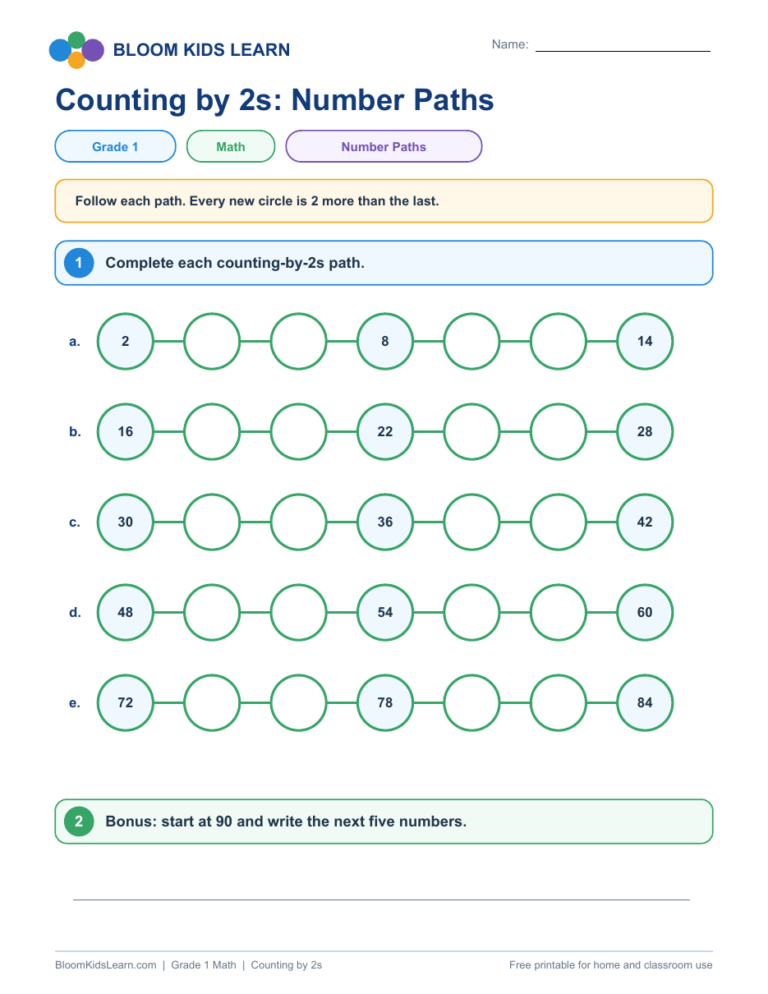
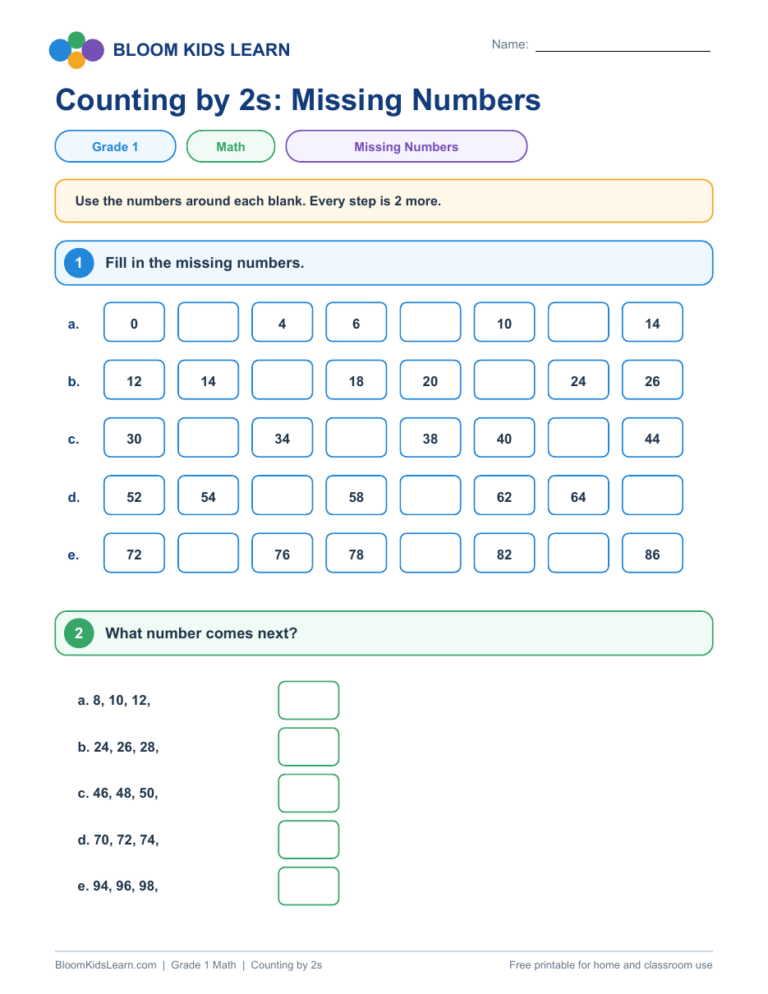
Begin with the Counting by 2s Basic Practice Worksheet when the sequence is new. Use the Missing Numbers Worksheet for extra clue-based practice, or try the Number Paths Worksheet for a visual sequence layout. The full Counting by 2s worksheet collection keeps all activities together.
Frequently asked questions
Can children use counters?
Yes. Counters help children understand why each new total is two more. Remove them gradually after the learner can count the pairs accurately.
Does counting by 2s always begin at 2?
No. Any starting number can be followed by adding 2. This worksheet uses several even starting numbers so children practice the rule flexibly.
Is a separate answer key required?
No separate file is needed for this individual page. The complete answers are provided in the answer-guidance section above.

 Preview