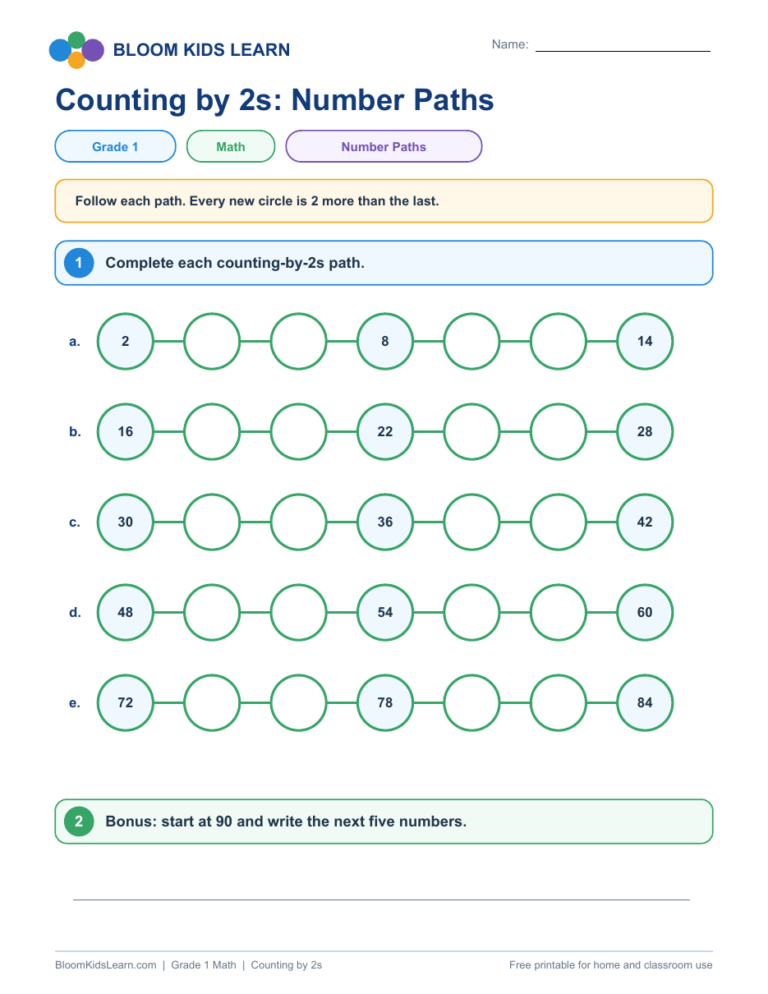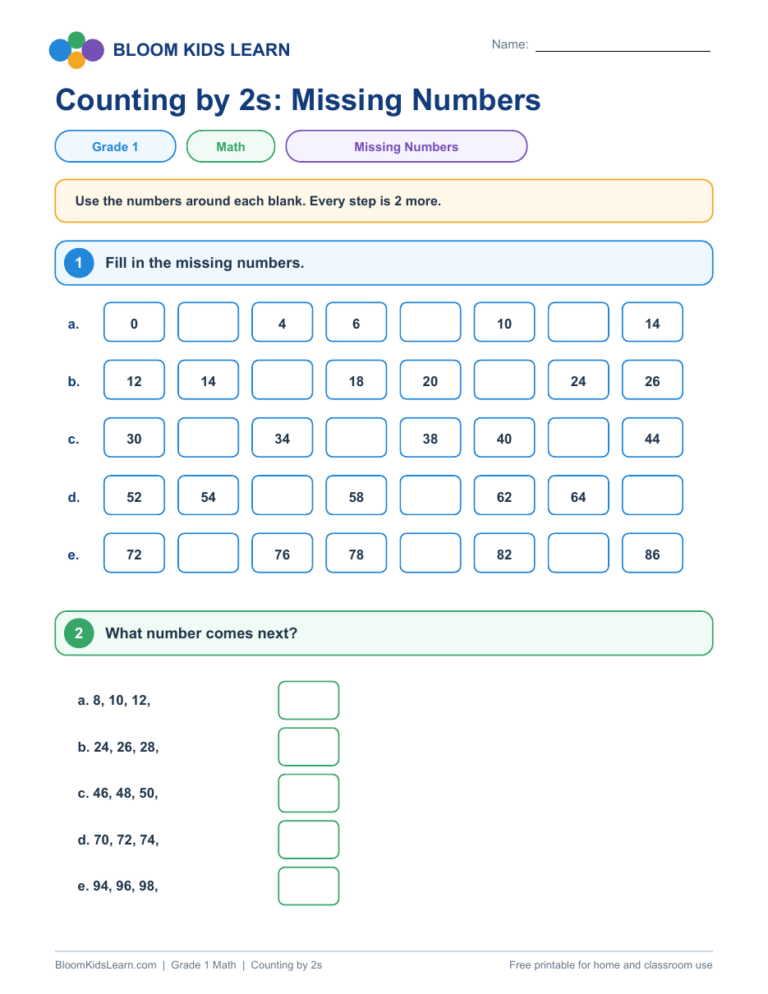

Counting by 2s Mixed Practice Worksheet for Grade 1
Practice counting by 2s with missing numbers, multiple-choice sequences, number lines, and short counting-on problems in this free Grade 1 worksheet.
- Skill: Use counting by 2s across sequences, choices, and number lines
- Learning goal: Complete mixed counting-by-2s tasks and explain that each next number is two more.
- Format: Printable PDF worksheet
 Download Worksheet PDF
This free Grade 1 counting by 2s mixed practice worksheet gives children four different ways to use the same number pattern. Instead of repeating one exercise, learners complete missing-number sequences, choose the next value, fill number lines, and solve short “count more” prompts. The variety makes this printable useful after a child has learned the basic 2, 4, 6, 8 pattern and is ready to show that the rule still works in a new format.
Download the printable PDF for a short math lesson, homework check, independent center, or homeschool review. The page stays within familiar two-digit numbers and gives enough repetition to build confidence without turning the activity into a long drill.
Download the Counting by 2s Mixed Practice PDF
What children practice on this worksheet
The first section contains five counting rows with selected numbers missing. Children use the numbers before and after each blank to decide what belongs there. The rows begin at 2, 10, 18, 26, and 34, so the learner cannot depend on always starting from 2. This encourages flexible skip counting rather than memorizing only one chant.
Next, children look at a short sequence and circle the number that comes next. Each question includes three choices, so students must compare the options instead of writing from memory. The number-line section then presents four paths from 0 through 40. Learners fill two missing labels on each line while noticing that every tick advances by two.
The final section asks children to count 2, 4, or 6 more from a given number. These prompts connect the spoken phrase “count on” with addition. For example, counting 4 more from 26 gives 30. A student may solve it by saying 28, 30 or by recognizing that 26 + 4 = 30.
Learning goals
- Continue an increasing number sequence by adding 2.
- Find missing even numbers within 46.
- Choose the next number from plausible answer choices.
- Read equal jumps on a number line.
- Connect counting on by 2s with adding 2, 4, or 6.
How to teach the worksheet
Begin with a quick oral warm-up. Ask the child to count 2, 4, 6, 8, 10 while moving two counters at a time. Then point out the rule: every new number is exactly two more than the previous number. Write one example, such as 18, 20, __, 24, and think aloud: “Two more than 20 is 22, and 22 is two less than 24.” This models how to use clues on both sides of a blank.
Let the learner complete the first row independently before moving to the multiple-choice questions. Encourage the child to say the full sequence quietly. Hearing the rhythm often helps a first grader notice an incorrect choice. On the number lines, have the student trace each jump with a finger and say the labels aloud. For the final prompts, counters or a small number line can remain available until the child is ready to work mentally.
Worked examples
Missing number example
In the row 10, __, 14, the missing number is 12. Start at 10 and add 2. Check the answer by adding 2 again: 12 + 2 = 14.
Next number example
For 18, 20, 22, the next number is 24. The choices include nearby values, but only 24 keeps every jump equal to two.
Number-line example
On the line labeled 20, 22, __, 26, __, 30, the missing labels are 24 and 28. Each tick represents one jump of two, even when the printed number is missing.
Common mistakes and helpful corrections
A child may accidentally count by 1 and write 5 between 4 and 6. Return to a pair of counters and move both pieces together to show why the total changes by two. Another common error is choosing a number that is two less instead of two more. Ask the learner to check whether the row is increasing from left to right.
Some students focus only on the first clue and skip a blank. Have them point to every box or tick while reading the completed row. If the final “count more” prompts are confusing, separate the total increase into jumps of two. Counting 6 more from 40 can be shown as 42, 44, 46. Three jumps of two produce an increase of six.
Answer guidance
Section 1 answers are: row a, 6 and 10; row b, 12, 16, and 20; row c, 22 and 28; row d, 28 and 34; row e, 38 and 42. Section 2 next numbers are 8, 16, 24, 32, and 40. Section 3 missing number-line labels are 4 and 8; 14 and 18; 24 and 28; 34 and 38. Section 4 answers are 14, 30, 46, and 54.
When checking, ask the child to explain one answer rather than correcting every mistake immediately. A useful explanation is, “I added two each time.” That short sentence shows the learner understands the pattern instead of guessing from the appearance of the numbers.
Support and extension ideas
For extra support, cover all but one row at a time and provide a strip numbered from 0 to 50. Highlight the even numbers or let the learner place a counter on each value used. If writing slows the lesson, the child may say the answers first and write them afterward.
For an extension, ask the learner to continue any completed row for three more numbers. Children who are ready for a deeper challenge can start at an odd number, such as 7, and count 7, 9, 11, 13. The rule is still “add two,” even though the results are odd. Another useful task is to create a new multiple-choice question with one correct next number and two believable distractors.
Related counting by 2s worksheets
If the mixed format feels difficult, return to the Counting by 2s Basic Practice worksheet. The Number Paths worksheet provides additional visual sequence practice, while the Count and Write worksheet connects pairs of objects with written totals. Visit the complete Counting by 2s worksheet collection to see the full learning sequence.
Frequently asked questions
Is this worksheet suitable for independent practice?
Yes, after a child can reliably add two to a number. Learners who are still building the pattern may benefit from counters or a number line nearby.
How long should the activity take?
Most children can complete it in about 10 to 15 focused minutes. It is also fine to complete two sections now and return to the others later.
Does skip counting by 2 always start at 2?
No. This printable uses several even starting numbers. The same add-two rule can also begin at an odd number when the learner is ready for an extension.

 Preview