
Continue a Pattern Worksheets for Grade 1
Six free Grade 1 continue-a-pattern worksheets covering add 1, add 2, add 5, add 10, mixed practice, and challenge work, plus answers.
- Skill: Continue and explain number patterns with several rules
- Learning goal: Build from simple forward-counting rules to independent mixed-pattern reasoning and challenge problems.
- Format: Printable PDF worksheet
- Answer key: Separate PDF available
 Download Worksheet PDF
 View Answer Key
These six Grade 1 continue-a-pattern worksheets form a purposeful progression from counting forward by one to comparing several pattern rules independently. The collection includes focused practice for adding 1, 2, 5, and 10, followed by a mixed review and a challenge page. Every printable is US Letter size, and the downloadable pack includes a complete six-page answer key.
A child does not need to finish the set in one day. Choose the page that matches the learner’s current understanding, observe the strategy used, and move forward when the child can explain the rule as well as write the answers.
1. Count forward by 1
The Count Forward by 1 Pattern Worksheet begins with consecutive numbers and then places blanks inside rows and visual paths. Starting values vary, including sequences near a decade change. Use this page when a child can count from 1 but needs practice continuing from numbers such as 45 or 78.
Key question: Is each answer exactly one more than the number before it?
2. Skip count by 2s
The Skip Counting by 2s Pattern Worksheet includes both even and odd starting points. This matters because adding 2 is a general rule, not only the memorized chant 2, 4, 6, 8. Children complete rows, missing values, pattern paths, and a short challenge.
Key question: Does the pattern keep the same even-or-odd type while increasing by two?
3. Continue patterns by adding 5
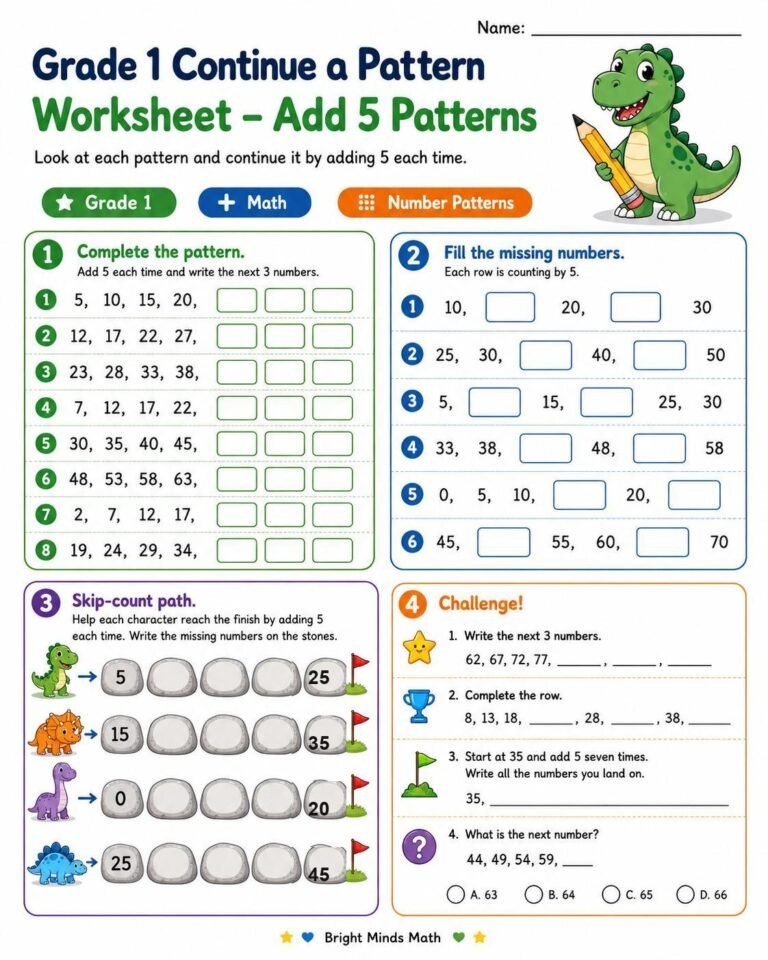
The Skip Counting by 5s Pattern Worksheet uses familiar multiples of five and less familiar starts such as 12, 23, and 33. This prevents children from relying only on a rehearsed list. The corrected skip-count paths now maintain a consistent +5 rule from every starting stone to its endpoint.
Key question: Can the child show that every neighboring pair differs by five?
4. Use place value to add 10
The Counting by 10s Number Patterns Worksheet highlights a useful place-value pattern: the tens digit changes while the ones digit remains constant. Number trains and missing values help children apply the idea from varied starts rather than only 10, 20, 30.
Key question: Does the ones digit stay the same as one ten is added?
5. Mixed number and picture patterns
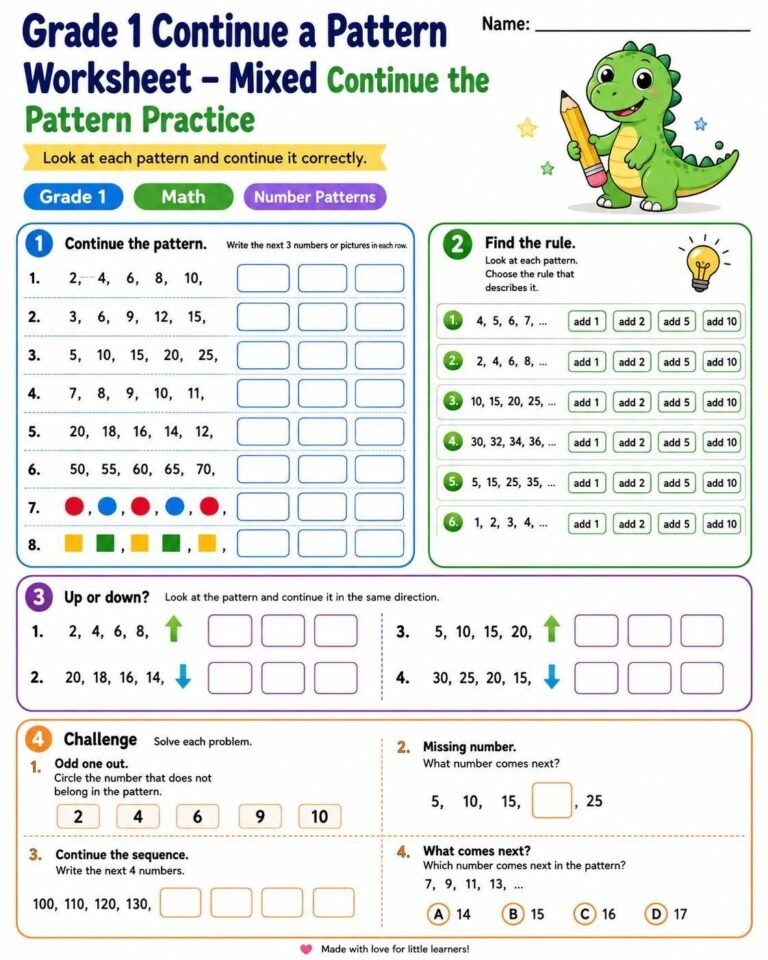
The Mixed Number Patterns Worksheet removes the safety of a rule printed in every direction. Learners decide whether a sequence goes up or down, identify +1, +2, +5, or +10, continue repeating picture patterns, and solve four review questions.
Key question: Can the child identify the direction and test the same difference more than once?
6. Pattern challenge
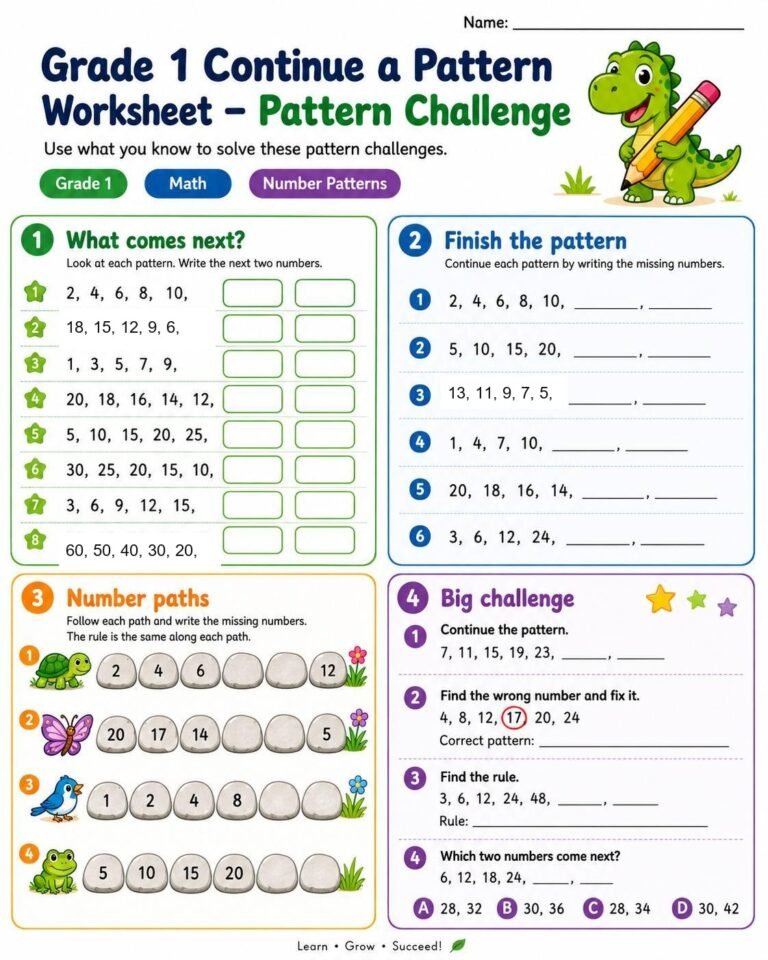
The Number Pattern Challenge Worksheet combines equal jumps, decreasing patterns, paths, error correction, and a doubling stretch item. Use it as an assessment after the focused pages. The decreasing rows in this corrected edition finish at zero or above, so children are not unexpectedly required to enter negative numbers.
Key question: Can the learner explain why a chosen rule works throughout the sequence?
A teaching sequence that avoids guesswork
- Read: Say the printed numbers aloud.
- Compare: Decide whether values increase, decrease, or repeat.
- Find the change: Measure the first jump.
- Test: Check the same change on a second pair.
- Continue: Write one value at a time and recheck.
For example, in 12, 17, 22, 27, the sequence increases. The first difference is 5, and the next difference is also 5. The next numbers must therefore be 32, 37, and 42. This reasoning is stronger than guessing from the last printed value.
How to choose the right worksheet
Start with +1 if the child loses ordinary counting order or struggles at decade transitions. Choose +2 when the learner is ready for equal jumps but benefits from a number line. Use +5 and +10 to connect patterns with skip counting and place value. Move to mixed practice when focused rows are accurate. Save the challenge for a learner who can name and test a rule without prompting.
If a child writes a beautiful but incorrect continuation, the difficulty is probably sequence reasoning rather than handwriting. If the rule is explained correctly but numerals are reversed, choose targeted number-writing practice without reteaching the pattern concept.
Answers and downloads
The main download combines all six worksheets followed by six answer-key pages. You can also open the separate Continue a Pattern answer key when you already printed individual pages. Answers follow each worksheet’s reading order, including paths, multiple-choice items, picture patterns, and the challenge correction.
Frequently asked questions
Are these worksheets only for skip counting?
No. Four pages use constant addition rules, while the mixed and challenge pages also include decreasing sequences, repeating pictures, error correction, and doubling.
Should children use a hundred chart?
A chart is helpful during guided practice, especially for +10. Remove it gradually once the learner can predict the next value and explain the rule.
Do I need to print the entire pack?
No. Each worksheet has its own PDF, and the full pack is available for teachers or families who want the complete progression with answers.
For related rule-identification work, visit our Grade 1 Number Pattern Worksheets collection. It focuses on finding, choosing, and checking rules before learners extend longer sequences.
 Preview