
Middle Sounds Mixed Practice Worksheet for Grade 1
Check whether a learner can carry middle-sound knowledge across writing, matching, choosing, odd-one-out and open-response tasks.
- Skill: Apply short-vowel middle-sound knowledge across varied CVC tasks
- Learning goal: Independently select and apply an appropriate strategy to identify, write, compare and use medial vowels.
- Format: Printable PDF worksheet
- Answer key: Separate PDF available
 Download Worksheet PDF
 View Answer Key
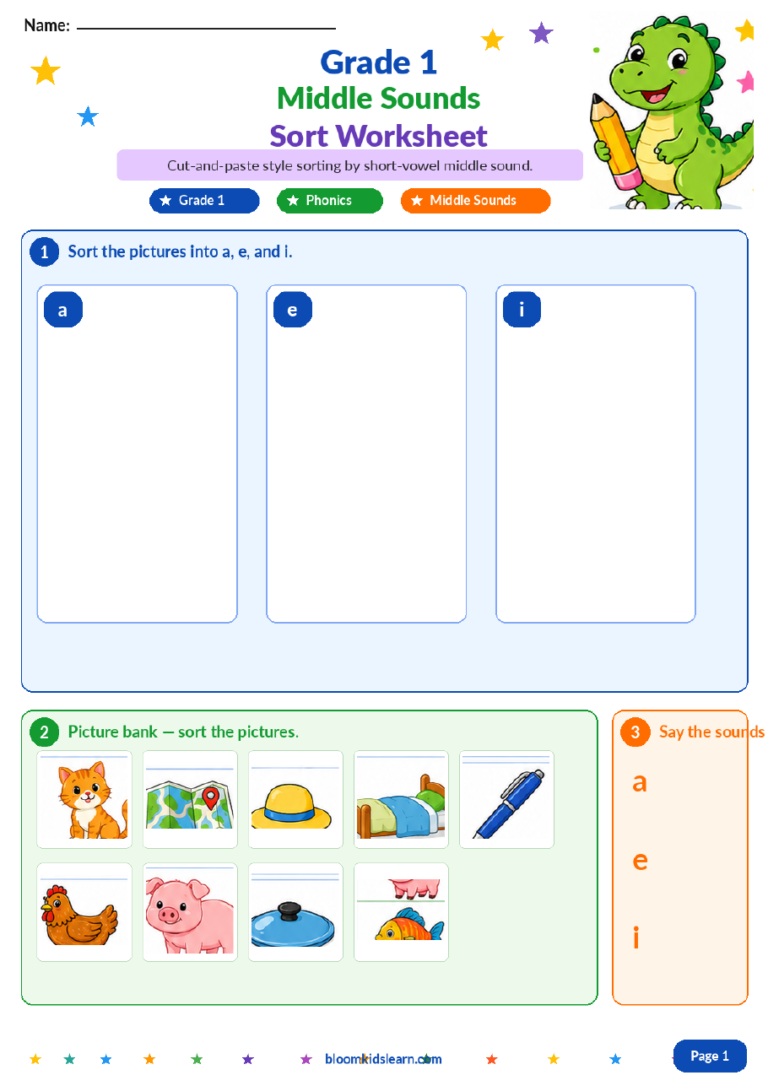
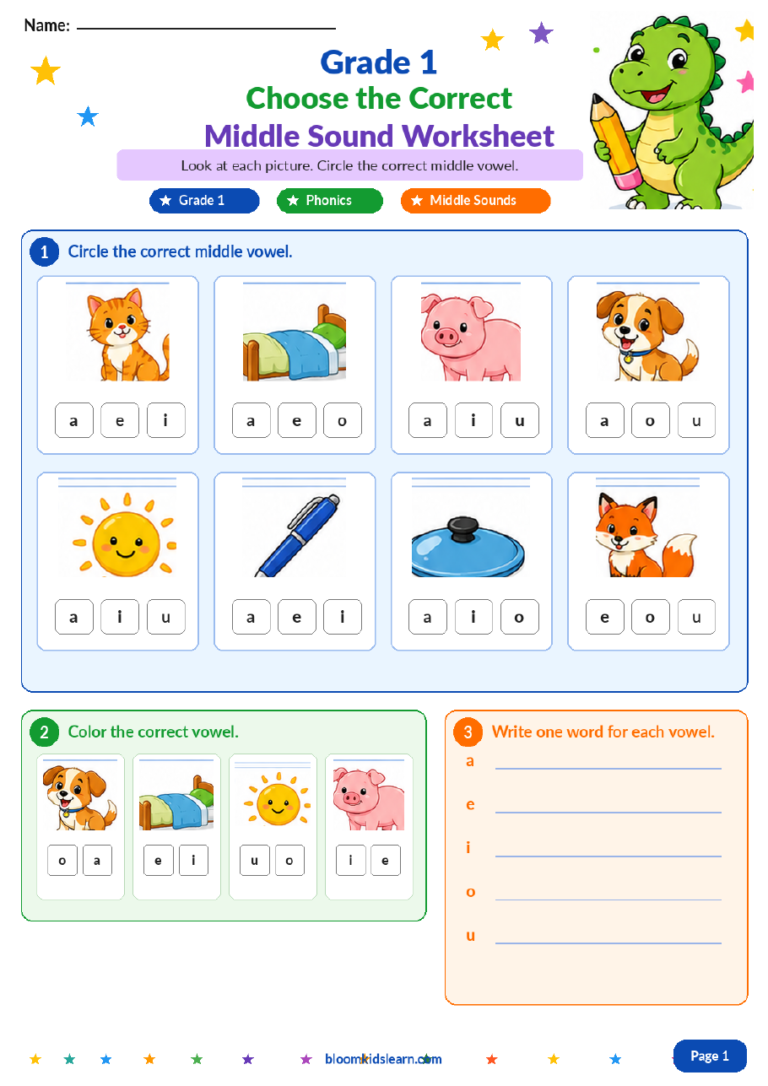
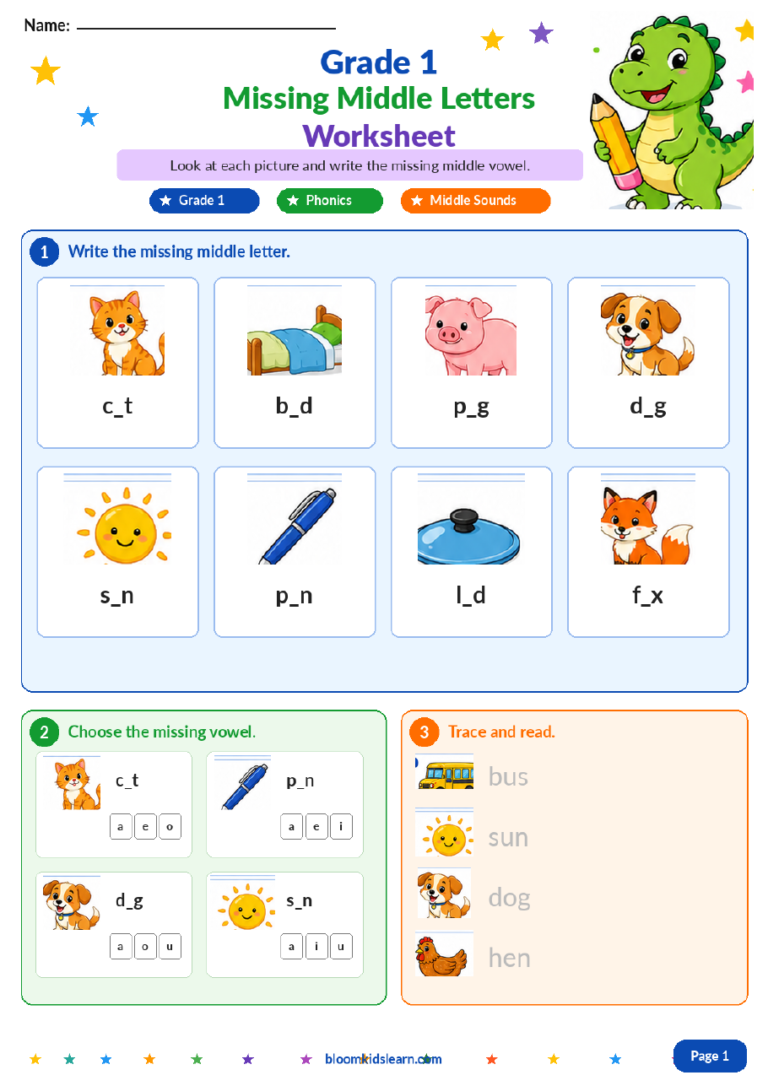
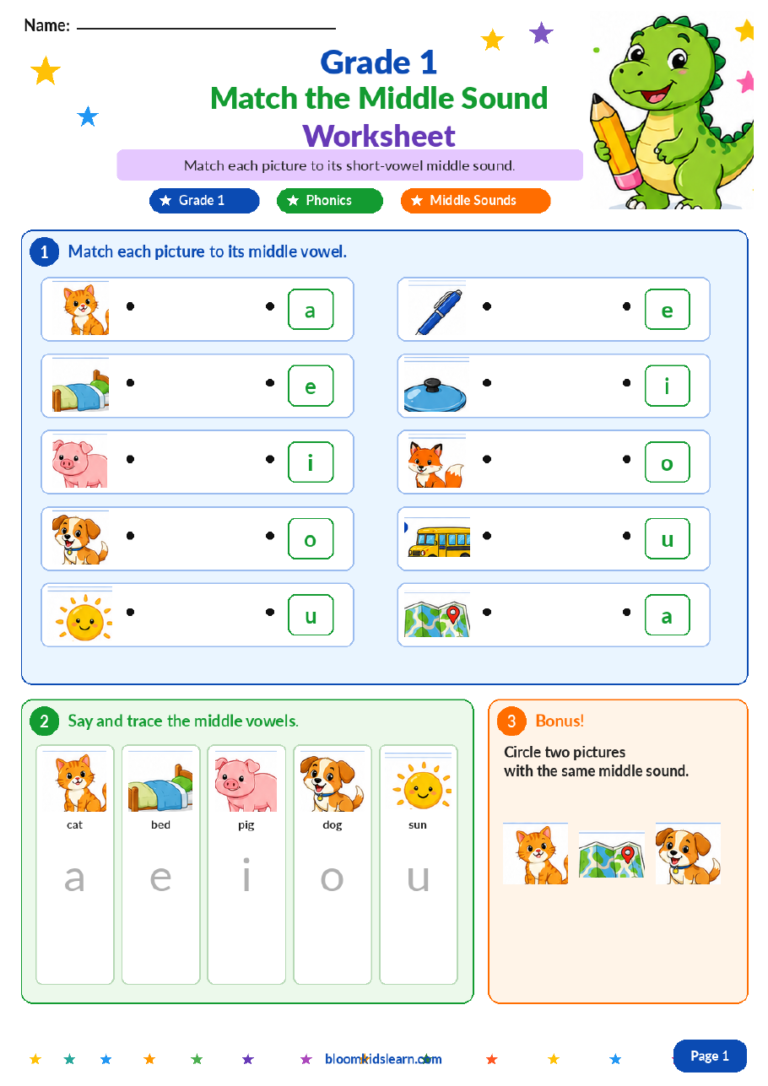
Middle-sound knowledge is more secure when it works across formats, not only on a familiar page. This middle sounds practice worksheet for Grade 1 mixes writing, picture selection, matching, missing vowels, odd-one-out reasoning, and an open response. It can be used after focused short-vowel work or as a quick check before moving into broader CVC reading.
Download and Print the Middle Sounds Practice PDF
Download the Middle Sounds Answer Key PDF
The supplied middle sounds answer guide covers the core checkable items. Drawing and original-word responses may have several correct answers.
What Does This Grade 1 Worksheet Practice?
The worksheet reviews all five short vowels in the middle of familiar CVC words. Learners identify and write medial vowels, match vowel labels to pictures, compare groups, read incomplete words, and explain an exception. These activities combine phonemic awareness with decoding and early spelling.
Because the tasks change, the page can show whether a child owns the strategy or relies on one layout. A learner who succeeds at matching but stalls when the choices disappear needs more recall practice. A learner who spells accurately but misses odd-one-out rows may need help comparing several words at once.
What’s Included in This Worksheet?
Page 1 begins with six pictures: cat, dog, fish, hat, sun, and rug. Children write the middle sound for each. A five-row selection task asks them to find a picture with a given vowel, followed by a match from a, e, i, o, and u to cat, bed, pig, dog, and sun. The challenge asks for a word containing short i.
Page 2 asks learners to complete c_t, h_t, d_g, f_sh, s_n, and r_g. A reading-and-matching section uses cat, bed, fish, dog, and sun. Three odd-one-out rows test comparison: bed differs from the short-a words, sun differs from the short-o words, and bus differs from the short-i words. The final prompt asks the child to draw a short-vowel word and label its vowel.
How to Teach Mixed Middle-Sound Practice to Grade 1 Kids?
Before printing, confirm that the learner can identify at least four vowels in short, familiar words. Begin the session with five oral examples: cat, bed, pig, dog, and sun. For each word, tap three sounds and say only the middle phoneme. This brief warm-up reminds the child of the strategy without rehearsing every worksheet answer.
During the page, keep one prompt consistent: “Say it, stretch it, find the middle, then answer.” Do not switch to telling the vowel as soon as the format changes. The same listening routine should support matching, writing, and sorting.
How to Use This Worksheet effectively?
- Complete the oral five-vowel warm-up.
- Let the learner work through one section independently.
- Mark uncertain items with a small dot instead of supplying the answer.
- Ask the child to explain the odd-one-out choice using the middle sound.
- Review errors by vowel pair and task type.
- Choose the next worksheet from the error pattern rather than repeating both pages automatically.
For support, divide the worksheet across two sessions and provide movable vowel cards. For an extension, cover the pictures in the reading section and ask the learner to decode the words from print alone, then write a second example for each vowel.
How Does This Worksheet Help Grade 1 Students?
Mixed practice checks flexibility. The child must move between hearing, selecting, writing, reading, and comparing while keeping the same phonics idea in mind. The result also gives parents and teachers useful diagnostic detail. Errors concentrated in e/i call for a focused contrast; errors only in open writing point to recall or handwriting; errors across every format suggest returning to oral segmentation.
Common Mistakes and How to Help your Bloom Kids?
One vowel is used for nearly every answer. Pause the written work and contrast two picture words. Ask the learner to feel and hear the difference, then return to only the affected row.
The odd-one-out picture is chosen by appearance. Name all four pictures and record their middle vowels underneath. The exception becomes clear when the sounds, not the objects, are compared.
Missing vowels are completed correctly but the words are not read. Require a quick blend after each answer. Writing a in c_t is useful only when the learner connects the completed spelling with cat.
Open responses are avoided. Offer a familiar starting choice: “Would you like to draw cat, dog, or sun?” Reduce the memory demand without completing the phonics decision.
What Should Your Child Practice Next?
If the page is mostly accurate, continue with the Grade 1 CVC word worksheets and then the CVC Sentences Worksheet. If one task remains difficult, return to the matching, choosing, missing-letter, or middle sounds sorting practice listed on the Middle Sounds Worksheets hub.
Frequently Asked Questions
When should Grade 1 students begin mixed middle-sound practice?
Use mixed practice after the learner can usually identify individual short vowels in familiar CVC words. It is a review and transfer task, not the best first introduction to all five sounds.
How do I know whether a child has mastered middle sounds?
Look for accurate responses across listening, matching, writing, and reading without immediate adult hints. The child should also be able to explain the medial sound in a new familiar CVC word.
What if a child still confuses two short vowels?
Remove the other vowels temporarily and practice the two sounds with a small set of clear picture words. Return to mixed review after the contrast becomes more consistent.
What should students practice after middle vowel sounds?
Move into blending complete CVC words, reading word families, spelling from dictation, and then reading short CVC sentences. Keep brief vowel review available if decoding becomes guesswork.
 Preview