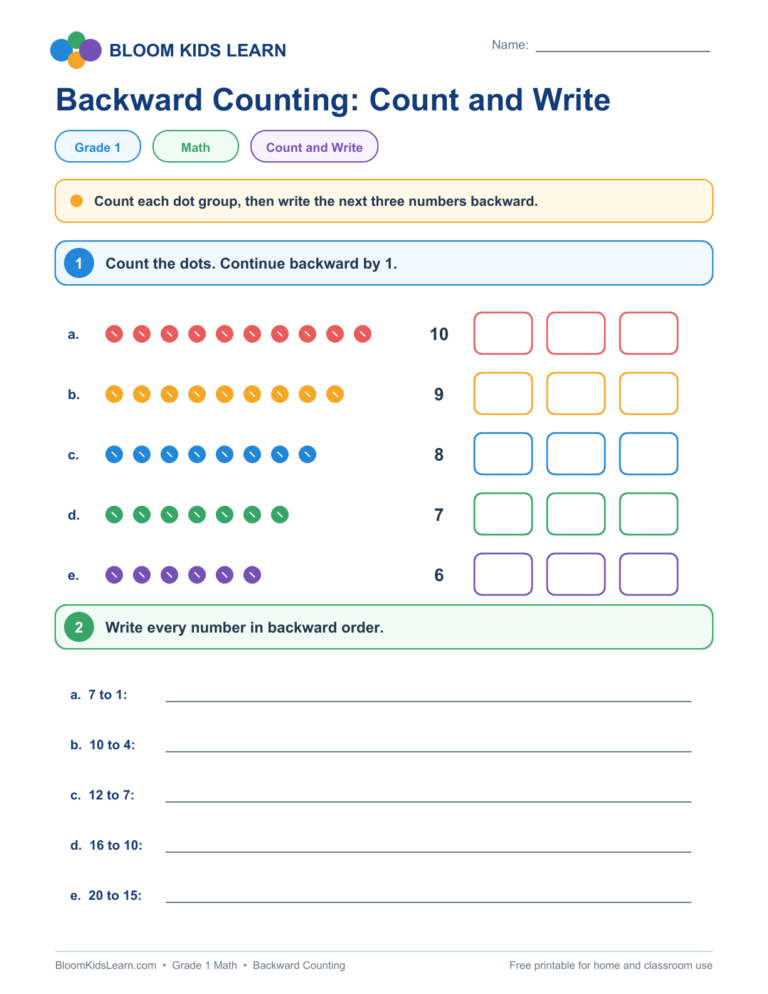
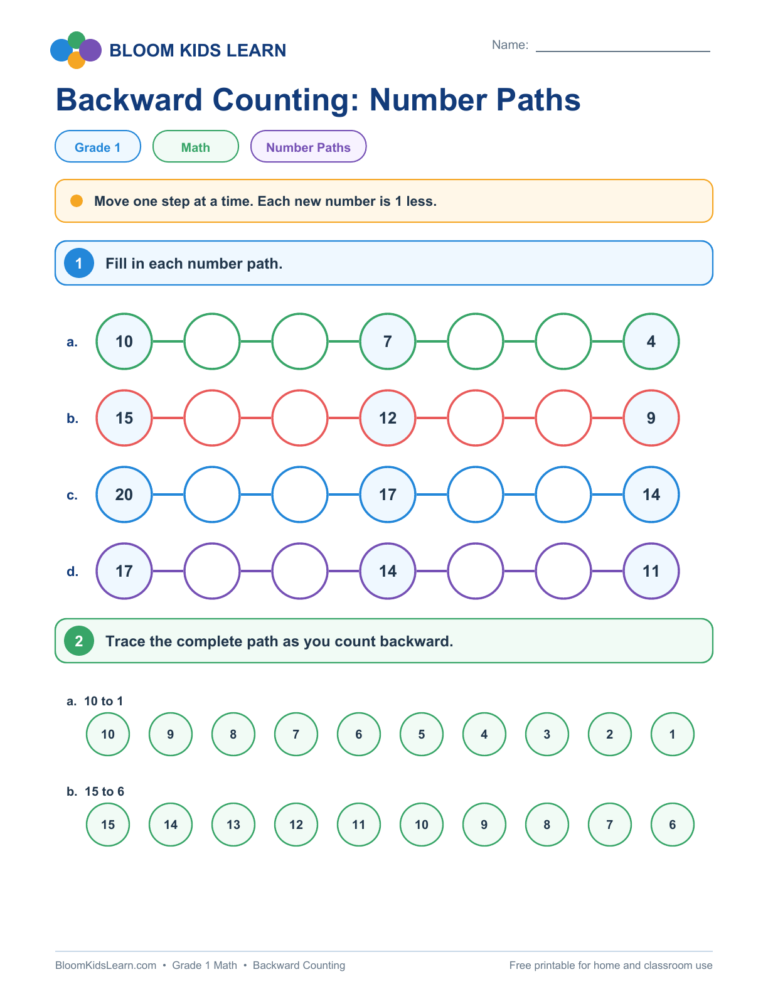
Backward Counting Basic Practice Worksheet for Grade 1
A free Grade 1 printable for practicing backward counting by 1 within 20 with short sequences and longer written counting rows.
- Skill: Counting backward by 1 within 20
- Learning goal: Count backward by 1 and complete number sequences within 20.
- Format: Printable PDF worksheet
 Download Worksheet PDF
A child who can count forward confidently may still pause when asked, “What number comes before 12?” This free backward counting worksheet for Grade 1 gives that skill clear, focused practice with numbers up to 20. Each row begins with several printed numbers so students can hear the decreasing pattern before they complete the empty boxes.
Counting backward is more than reciting a countdown. Children learn that moving back one place produces a number that is one less. That relationship supports number sense and creates a useful bridge to early subtraction.
What children practice on this worksheet
- counting backward by 1 from numbers within 20;
- identifying the number immediately before another number;
- keeping a descending sequence in the correct order;
- writing missing numerals clearly;
- checking that every step is exactly one less; and
- completing a longer countdown with less adult support.
The early rows offer a visible starting pattern, while the longer sequences require students to continue the same rule. This gradual increase makes the page suitable for guided practice followed by independent work.
Prepare with a short hands-on countdown
Place ten small objects on a table. Count them together, remove one object, and count the amount that remains. Say the two numbers as a sentence: “We had 10. One less is 9.” Continue for several steps. The objects make the decrease visible and help the phrase “one less” feel meaningful.
Next, ask the child to count backward aloud from 10 to 1 without writing. If a number is skipped, return to the last correct value and continue. A smooth oral countdown is helpful, but it does not need to be fast before beginning the worksheet.
Step-by-step directions for students
- Find the first printed number in a row.
- Point to each number and read the row aloud.
- At a blank, think of the number that is one less.
- Write that number in the empty box.
- Continue moving across the row and decreasing by one each time.
- Read the completed sequence backward to check for skips or repeats.
Completing the first row together can clarify the routine. After that, let the student try the next row independently and explain how each answer was found.
Teach the idea of one less
Backward counting becomes easier when students connect it to quantity. If the current number is 14, the next number in a backward count is 13 because 13 is one less than 14. Use that language repeatedly: “One less than 14 is 13.”
A number line can provide visual support. Place a finger on the starting number, then move one space to the left for each step. Avoid jumping several spaces at once. The learner should see that every backward move changes the value by exactly one.
When the child no longer needs the number line, ask for a quick mental answer before writing. Moving gradually from objects to a visual tool and then to mental counting builds independence without unnecessary pressure.
Worked backward-counting examples
Suppose a row begins 15, 14, 13, __. Read the printed values and notice that each one is one less. One less than 13 is 12, so 12 belongs in the blank. Check by reading 15, 14, 13, 12.
For two blanks, such as 9, 8, __, __, fill them one at a time. One less than 8 is 7, and one less than 7 is 6. The completed sequence is 9, 8, 7, 6. Writing both answers from a guess makes it easier to reverse their order, so encourage one careful step at a time.
Common mistakes and helpful corrections
A frequent mistake is switching back to forward counting. Point to the starting number and ask, “Are the numbers getting smaller or larger?” Then say the first two values aloud and identify the rule.
Some students skip a number because they are trying to finish quickly. Have them touch each box while reading the completed row. A skipped value will usually sound wrong. Others repeat the current number in the next box; asking for “one less” instead of simply saying “next” can prevent that confusion.
Digit reversals may appear in numbers such as 12 and 15. Ask the child to name the intended number, identify the tens digit, and write slowly. Correct numeral formation is part of useful practice, but it should not overshadow the counting strategy.
Support for learners who need more help
Cover the lower part of the page and work with one row at a time. Allow counters, fingers, or a number line, and invite the child to say each answer before writing. If numbers above 10 are difficult, rehearse countdowns within 5 and then within 10 before returning to the page.
Short sessions are effective. Complete two or three rows, pause, and revisit the remaining work later. This keeps handwriting fatigue from being mistaken for a number-order difficulty.
Extension ideas for confident students
Ask the learner to begin at a new number within 20 and write a five-number countdown. Another option is to hide one written value and have the child identify the missing number from both neighbors.
Classroom and home uses
This printable works as morning practice, a math-center task, homework, or a brief small-group lesson. Teachers can place it in a dry-erase sleeve for repeated countdown practice. At home, adults can turn the final row into a speaking game by taking turns saying alternate numbers.
How to check the answers
Begin at the first number in each row and read from left to right. Every new value should be exactly one less than the value before it. Mark the first place where the rule breaks, then ask the child to recount from the nearest correct number.
For longer rows, check the sequence orally and then inspect the written numerals. A corrected answer should be explained, not simply copied. For example, “I changed 8 to 7 because one less than 8 is 7.”
Continue learning in sequence
Backward counting is easier when forward number order is secure, so review the Grade 1 forward counting worksheets if needed. After this basic page, continue with the Backward Counting Missing Numbers worksheet, where children must use clues on both sides of a blank. Browse the full Backward Counting collection for all six printable activities.
This practice also connects with the official Grade 1 Common Core counting standard, which expects students to read and write numerals and count from different starting numbers.
Frequently asked questions
Should a child use fingers to count backward?
Yes. Fingers are a useful temporary model for one less. Encourage the learner to rely on them less often as the countdown becomes familiar.
What if the student always starts at 20?
Give short countdowns from varied starting numbers, such as 13 or 8. This builds flexibility and shows that a backward sequence can begin anywhere.
How much practice is enough?
Five to ten focused minutes is often useful for a first grader. Stop before frustration or tired handwriting reduces the quality of the practice.
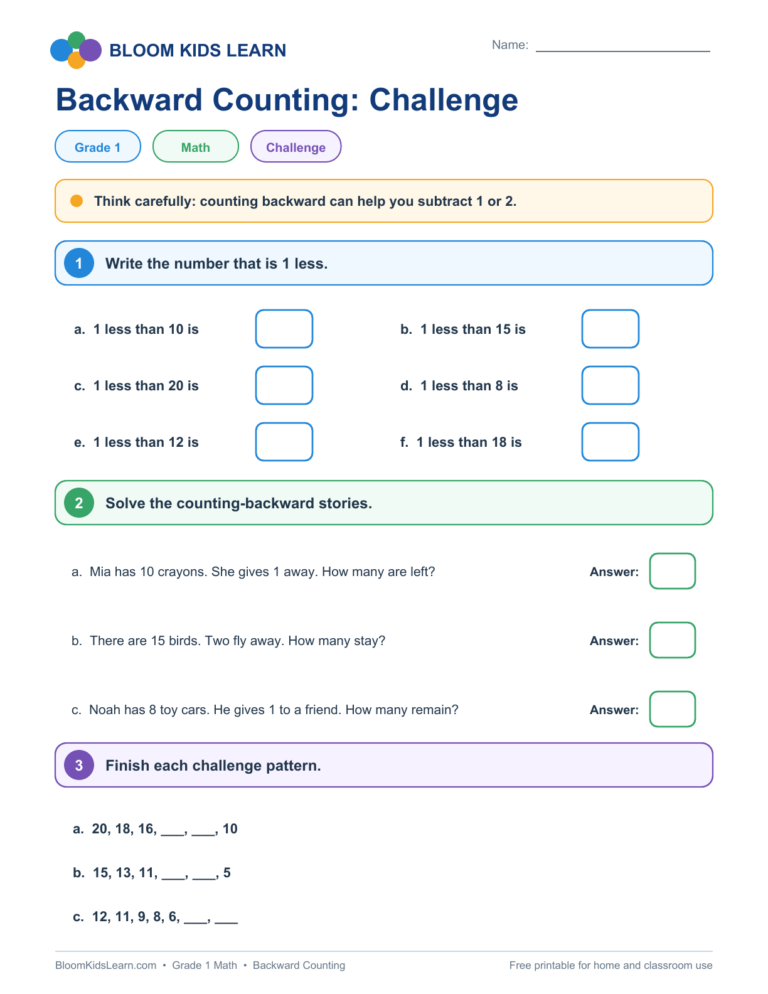
 Preview