

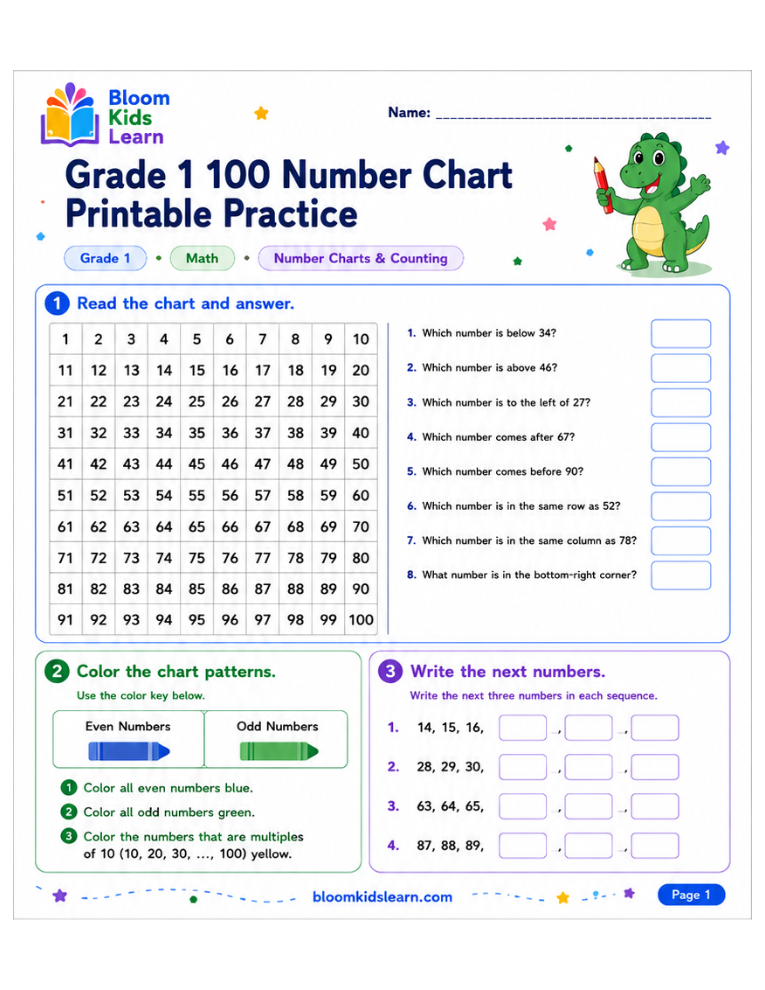
1–100 Number Chart Worksheet for Grade 1
- Skill: Read a 1-100 chart and identify neighboring numbers
- Learning goal: Complete a 1-100 chart, solve neighbor clues, and use visual marks to identify number patterns.
- Format: Printable PDF worksheet
 Download Worksheet PDF
1-100 number chart worksheet chart is a map of the numbers 1 through 100. Once children understand how the map is organized, they can use position as evidence instead of counting from 1 for every missing square. This Grade 1 worksheet develops that chart-reading skill through missing numbers and pattern practice.
How a 1–100 chart works
On a standard chart with ten columns, numbers increase by 1 as you move from left to right. Moving one square left means 1 less. Moving down one row means 10 more, and moving up one row means 10 less.
- Right: +1
- Left: −1
- Down: +10
- Up: −10
Model the moves with a printed number. From 34, one square right is 35 and one square left is 33. Directly below 34 is 44; directly above it is 24.
What’s inside the Worksheet? Rows, columns, and same-digit patterns
Each row contains ten consecutive numbers. Across the row beginning with 41, children see 41, 42, 43 and continue to 50. Down a column, the ones digit stays the same: 7, 17, 27, 37, and so on. Recognizing this pattern makes vertical clues especially useful.
Ask the child to circle a column and describe what stays the same. Then compare the tens digits. This connects the chart to place value: moving down adds one ten without changing the number of ones.
How to solve a missing square?
First look left and right. If the blank sits between 46 and 48, it must be 47. Then check vertically: the square above should be 37 and the square below should be 57. Using both directions proves the answer.
If only one neighbor is printed, use the chart move. A blank directly below 62 is 72 because down means 10 more. A blank to the left of 90 is 89 because left means 1 less.
Decade transitions and How to decode it?
The end of a row can be confusing because 29 is beside 30 and 39 is beside 40. The next row begins with the next whole number, but the tens digit changes and the ones digit returns to zero. Have the child read 27, 28, 29, 30 slowly while tracking each square.
Some Errors to discuss to students.
- Writing 58 below 47 shows that the learner added 11 instead of 10.
- Writing 70 after 69 but placing it at the start of the wrong row shows a layout misunderstanding.
- Copying a nearby printed number may mean the child is not checking both row and column clues.
Check with two clues to solve the worksheet.
For every answer, ask for a horizontal clue and a vertical clue when both are available. This turns checking into reasoning: “It is one more than 46 and ten less than 57.” Learners needing simpler chart work can use the Number Chart Basic Practice Worksheet. For more reasoning, continue with the 100 Chart Challenge Worksheet or the Missing Numbers 1–100 Worksheet.
 Preview


